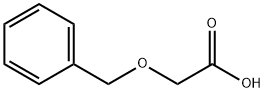
1. n-Butyllithium (1.6 M hexane solution, 5.0 mL, 8.0 mmol) was added slowly and dropwise to a tetrahydrofuran (THF, 10 mL) solution of diisopropylamine (1.1 mL, 8.0 mmol) at -30 °C and stirred continuously for 30 min at this temperature.
2. the reaction system was cooled down to -70 °C, a solution of (benzyloxy)acetic acid (0.60 g, 3.6 mmol) in THF (5 mL) was added slowly dropwise and stirred for 30 min at the same temperature.
3. Maintaining the -70 °C condition, 1-bromo-3-chloropropane (3.6 mL, 36 mmol) was added to the reaction mixture and stirring was continued for 30 minutes before the reaction system was slowly warmed to room temperature and stirred for 2 hours.
4. The reaction mixture was poured into ice-cold water and washed with ethyl acetate.
5. The pH of the aqueous layer was adjusted to 3-4 with 6 M hydrochloric acid and the mixture was subsequently extracted with ethyl acetate.
6. The organic layers were combined, washed with saturated brine, dried over anhydrous magnesium sulfate and concentrated under reduced pressure to remove the solvent.
7. The crude product was purified by silica gel column chromatography (eluent: hexane/ethyl acetate = 100/0 to 50/50 gradient elution) to afford 1-bromo-4-chlorobutane as a colorless oil (0.28 g, 32% yield). 8. The structure of the product was investigated by 1H NPD analysis.
8. The structure of the product was confirmed by 1H NMR (CDCl3): δ 1.91-2.06 (4H, m), 3.54 (2H, t, J=5.1 Hz), 4.08 (1H, t, J=6.6 Hz), 4.55 and 4.74 (2H, d, J=11.4 Hz), 7.34-7.39 (5H, m).