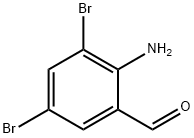
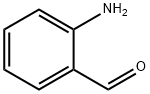
(1) Mix ethanol, water and o-aminobenzaldehyde with stirring at a molar ratio of 4:1:0.2. Elevate the temperature until the solid o-aminobenzaldehyde was completely dissolved; (2) add reduced iron powder, add 3 to 5 drops of hydrochloric acid, stir thoroughly, continue to elevate the temperature until the reaction system reached the reflux temperature, keep stirring the reaction, and monitor the progress of the reaction using high-performance liquid chromatography (HPLC); (3) after completion of the reaction, the reaction solution was filtered, and a mixture of bromine, potassium bromide, and water was added slowly to the filtrate by dropwise addition, and after completion of the dropwise addition, the Maintain the temperature and continue to stir the reaction; (4) add an excess of saturated sodium bicarbonate solution to the reaction mixture, stir well, precipitate a solid, and filter to obtain 2-amino-3,5-dibromobenzaldehyde. In this embodiment, the molar ratio of o-aminobenzaldehyde, bromine and potassium bromide was 1:1.93:9.5. The yield of 2-amino-3,5-dibromobenzaldehyde was 91.1% and the purity was 99.4%.