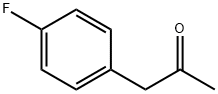
This intermediate, also known as (4-Fluorophenyl)acetone, presents as a dark yellow liquid. It is known to be insoluble in water. For best results, store in a tightly closed container in a dry and well-ventilated place. Containers which are opened must be carefully resealed and kept upright to prevent leakage. 4-Fluorophenylacetone is incompatible with strong oxidizing agents. This chemical is a combustible liquid.
4-Fluorophenylacetone is an important raw material and intermediate used in organic synthesis, pharmaceuticals, agrochemicals and dyestuff fields. It is a haloarylacetone derivative used in a study of reversed enantiopreference of an ω-transaminase by a single-point mutation.
(4-Fluorophenyl)acetone is a phenylacetic acid derivative that inhibits the 5-HT2 receptors. It has been shown to have inhibitory activities against dopamine and serotonin by acting as an agonist at the receptor. (4-Fluorophenyl)acetone also binds to nucleophilic sites on proteins, which may lead to inhibition of protein synthesis. Brevibacterium sp. strain P7 was used as a model system and it has found that it inhibited the growth of this bacterium by binding to the enzyme RNA polymerase, preventing transcription and replication.
4-Fluorophenyl acetone synthesis methods are mainly the following: (1) 4-fluorophenyl derivatives and acetone in the presence of catalysts such as manganese acetate to obtain; (2) -cyanoacetone-based m-fluorobenzene and sulfuric acid reaction can also be obtained; (3) by the starting material m-fluorotoluene through the side chain of bromination, hydrolysis to obtain m-fluorobenzaldehyde, and then after the addition of reaction with nitroethane and hydrolysis to obtain.