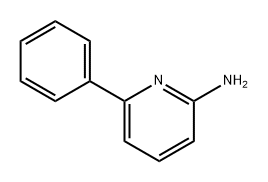
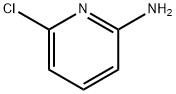
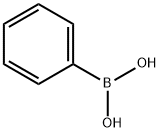
GENERAL STEPS: To a sealed tube was added a solution of anhydrous 1,4-dioxane (30 v/v) in 2-amino-6-chloropyridine (1.0 eq.), followed by phenylboronic acid (1.5 eq.) and finely ground potassium phosphate (2.0 eq.). The reaction mixture was degassed by nitrogen bubbling for 5 minutes, then palladium acetate (5 mol%) and di-tert-butylphosphinoferrocene (5 mol%) were added and degassing continued for 5 minutes. The reaction tube was sealed under nitrogen atmosphere and heated at 100 °C with vigorous stirring for 5 hours. Upon completion of the reaction, it was cooled to room temperature and the reaction mixture was vacuum filtered through a diatomaceous earth pad and the precipitate was washed with 1,4-dioxane. The filtrates were combined, concentrated under reduced pressure and purified by fast column chromatography (elution gradient: pure hexane to 1:1 hexane/ethyl acetate containing 2.5 vol% triethylamine) to give 6-phenylpyridin-2-amine.
[1] Bioorganic and Medicinal Chemistry, 2011, vol. 19, # 8, p. 2742 - 2750
[2] Tetrahedron Letters, 2005, vol. 46, # 20, p. 3573 - 3577
[3] New Journal of Chemistry, 2017, vol. 41, # 24, p. 15420 - 15432