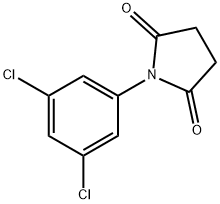
Dimethachlon is a fungicide found in pesticide compositions and is used in the treatment of necrotrophic fungal pathogen Sclerotinia sclerotiorum.
ChEBI: N-(3,5-Dichlorophenyl)succinimide is a member of pyrrolidines.
The production route for dimetachlone is not available in open literature. However, its production route can be inferred from its chemical identity and structure and would probably have followed the standard sequence for aryl substituted imides: chlorination or procurement of 3,5 dichloroaniline, conversion to the corresponding N aryl succinamic acid via condensation with succinic anhydride, and cyclodehydration to form the imide ring. The crude product would then be purified by crystallisation and drying to yield technical grade dimetachlone for formulation.
Limited systemic activity, mainly stomach but some contact action. Uncoupler of oxidative phosphorylation.
The nephrotoxicant, N-(3,5-dichlorophenyl)succinimide
(NDPS), undergoes non-enzymatic hydrolysis to N-
(3,5-dichlorophenyl)succinamic acid (NDPSA) in
buffer, rat liver and kidney homogenates, and rabbit
liver homogenates. In the presence of NADPH, rat
liver homogenates convert NDPS to NDPSA and N-
(3,5-dichlorophenyl)-2-hydroxysuccinamic acid (2-
NDHSA). Using liver homogenates from phenobarbital-
treated rats, N-(3,5-dichlorophenyl)-3-
hydroxysuccinimide (NDHS) and N-(3,5-
dichlorophenyl)-3-hydroxysuccinamic acid (3-NDHSA)
are also detected.