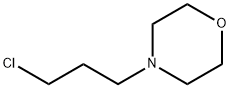
4-(3-Chloropropyl)morpholine is a hydrochloride salt of the potent inhibitor 4-(3-chloropropyl)morpholine. It has an inhibitory effect on cancer, and is used in chromatographic science to separate amines from aliphatic hydrocarbons. 4-(3-Chloropropyl)morpholine inhibits epidermal growth factor (EGF) and has been shown to have a potent inhibitory effect on EGF receptor tyrosine kinase activity. It also inhibits the proliferation of cells by inhibiting DNA synthesis. This compound causes cell death through the inhibition of protein synthesis, which may be due to its ability to inhibit nucleophilic reactions that are involved in protein synthesis. 4-(3-Chloropropyl)morpholine can also fluoresce under UV light, which makes it useful for research purposes.
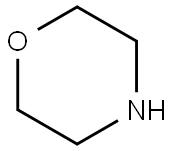
To a solution of 1-bromo-3-chloropropane (10.0 g, 63.5 mmol) in toluene (100 mL) was slowly added morpholine (11.0 mL, 127 mmol). The reaction mixture was placed under reflux conditions with continuous stirring for 2 hours. After completion of the reaction, the mixture was cooled to room temperature and filtered to remove insoluble impurities. The filtrate was washed sequentially with deionized water, and the organic layer was separated and dried over anhydrous sodium sulfate. The dried organic phase was concentrated under reduced pressure and subsequently purified by reduced pressure distillation to afford 4-(3-chloropropyl)morpholine (10.0 g, 96% yield). The structure of the product was confirmed by 1H NMR (300 MHz, DMSO-d6): δ 3.70-3.80 (m, 4H), 3.60 (t, 2H), 2.40-2.60 (m, 6H), 1.90 (m, 2H). Mass spectrometry analysis showed a molecular ion peak (M + H) of 164.
[1] Patent: US2009/185999, 2009, A1
[2] Patent: US9133137, 2015, B2. Location in patent: Page/Page column 18-19
[3] Synthetic Communications, 2003, vol. 33, # 14, p. 2483 - 2486
[4] Journal of Organic Chemistry, 2010, vol. 75, # 4, p. 1155 - 1161
[5] Bioorganic and Medicinal Chemistry Letters, 2009, vol. 19, # 4, p. 1066 - 1070