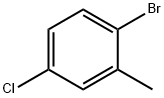
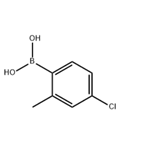
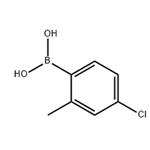
The general procedure for the synthesis of 2-methyl-4-chlorophenylboronic acid from 2-bromo-5-chlorotoluene was as follows: first, 13.3 mL (0.1 mol) of 2-bromo-5-chlorotoluene was dissolved in 200 mL of anhydrous tetrahydrofuran (THF), followed by the addition of 27.7 mL (0.12 mol) of triisopropyl borate. After cooling the reaction mixture to -78°C in a dry ice-acetone bath, 48 mL (0.12 mol) of 2.5 M n-butyllithium (n-BuLi, dissolved in hexane) was added slowly dropwise over a period of 1 hour. After completion of the dropwise addition, the dry ice-acetone bath was removed. 150 mL of 3N hydrochloric acid (HCl) was added to the reaction mixture and the resulting mixture was stirred for 1 hour. Subsequently, the separated aqueous layer was extracted twice with 100 mL of ethyl acetate. The organic layers were combined, washed with saturated brine solution and dried with anhydrous magnesium sulfate (MgSO). After removal of the solvent by filtration under reduced pressure, the residue was recrystallized by 10% ethyl acetate/hexane solvent mixture to give 13.8 g (81% yield) of 2-methyl-4-chlorophenylboronic acid as a white solid. The product was characterized by 1H NMR (300 MHz, CDCl) with chemical shifts of δ 8.07 (dd, 1H, J = 5.7 Hz, 2.8 Hz), 7.28-7.26 (m, 2H), 2.76 (s, 3H).