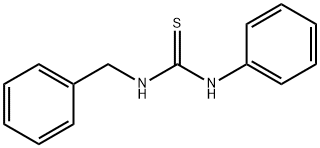
1-Benzyl-3-phenyl-2-thiourea (BPTU) is a thiourea derivative that contains benzene rings and polar groups. Its inhibition efficiency is related to the polar functions, acting as active centers for the adsorption. In addition, the presence of multiple benzene rings may increase the molecular coverage density. Therefore, BPTU is expected to become a potential corrosion inhibitor. The results showed that BPTU with a concentration of 2 × 10⁴ M and at the temperature of 30°C could protect the steel surface with the highest inhibition efficiency of 94.99% and 94.30%. High temperature decreased BPTU’s ability to inhibit steel corrosion[1].
1-Benzyl-3-phenylthiourea is a sensor material for detecting nerve agents and related simulants, and has biosensor activity. 1-Benzyl-3-phenylthiourea can be used to increase the sensitivity of sensors to nerve agents and enhance detection capabilities. The reaction characteristics of 1-Benzyl-3-phenylthiourea are similar to those of nerve agents and their simulants, making it show good results in detection[1].
Scanning electron microscopy (SEM) analysis confirmed that 1-Benzyl-3-phenyl-2-thiourea can form a protective film on the surface of low-carbon steel, effectively reducing pitting or crevice corrosion.
[1] Dinh, Q. H., Duong, T., & Cam, N. P. (2021). A Study of 1-Benzyl-3-phenyl-2-thiourea as an Effective Steel Corrosion Inhibitor in 1.0 M HCl Solution. <i>New Journal of Chemistry</i>, <i>13 1</i>, 1–14.
https://doi.org/10.1155/2021/5519411