Uses
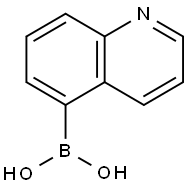
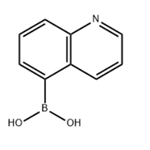
Quinoline-5-boronic acid is a fluorescent reporter compound that exhibits significant fluorescence property changes via a pKa-switching mechanism upon binding diols and carbohydrates in aqueous solutions at physiological pH[2]. Quinoline-5-boronic acid is used for monitoring sugars across a wide pH range, differentiating D-fructose from inulin, and functioning as a fluorescent probe for diols[2][3]. Quinoline-5-boronic acid is applied in fluorometric determination methods by combining with a phosphate buffer at neutral pH for selective D-fructose detection[3].
Synthesis
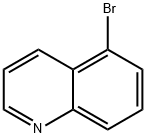
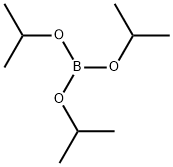
In a 100 mL three-necked flask, 5-bromoquinoline (10 mmol, 2.08 g) and anhydrous THF (50 mL) were added and n-butyllithium (11 mmol, 1.6 M, 6.88 mL) was added slowly and dropwise at -78 °C under nitrogen protection. After keeping the reaction at -78 °C for 2 h, a THF solution (5 mL) of triisopropyl borate (15 mmol, 3.03 g) was added slowly dropwise. After the dropwise addition, the reaction mixture was slowly warmed to room temperature and stirred overnight. The reaction was monitored by TLC to confirm the disappearance of the feedstock, then the reaction was quenched with 20% dilute hydrochloric acid (20 mL) and stirred at room temperature for 3 hours. Subsequently, the reaction mixture was extracted with ethyl acetate (50 mL x 3), and the organic phases were combined, washed with saturated brine (100 mL x 3) and dried with anhydrous sodium sulfate. After concentrating the organic phase, it was purified by column chromatography to afford quinoline-5-boronic acid (7.6 mmol, 1.31 g, 76% yield).
References
[1] Patent: CN107814795, 2018, A. Location in patent: Paragraph 0014; 0016
[2]Yang, W., Lin, L., & Wang, B. (2005). A new type of boronic acid fluorescent reporter compound for sugar recognition. Tetrahedron Letters, 46(46), 7981–7984.
https://doi.org/10.1016/j.tetlet.2005.09.074 [3]Rikita, T., Egawa, Y., & Seki, T. (2012). Fluorometric determination of inulin using 5-quinolineboronic acid and inulinase. Analytical Biochemistry, 426(1), 24–26.
https://doi.org/10.1016/j.ab.2012.03.029