Uses
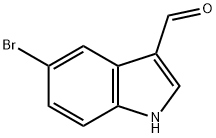
5-Bromoindole-3-carboxaldehyde serves as a precursor for synthesizing substituted indole derivatives via N-alkylation with 1-bromohexane or 1-bromooctane in the presence of potassium carbonate[1]. The compound inhibits quorum-sensing-dependent virulence factors in Pseudomonas aeruginosa strains Pa01, Pa14, and ATCC 27853[2].
References
[1]Roys, K. E., & L, M. S. (2023). Identification of novel indole-based dyes as active photo-sensitizers: Synthesis, photophysical, electrochemical and computational investigation. Optical Materials, 145, 114391.
https://doi.org/10.1016/j.optmat.2023.114391 [2]González, G. M., Falcón-González, J. M., Contreras, R. G., Alvarado-Salazar, J. A., Valdés, I. G., Valdés, N. G., Gutiérrez, D. A. L., Martínez, I. L. B., Alonso, A. R. T., Ramirez-Villalva, A., & Almeida, J. A. (2026). Molecular Insight into the Inhibition of <i>Pseudomonas aeruginosa</i> Quorum Sensing by 5-Bromoindole-3-carboxaldehyde and Curcumin: A Combined In Vitro Study, Molecular Dynamics, and Docking Studies. ACS Omega.
https://doi.org/10.1021/acsomega.6c02161