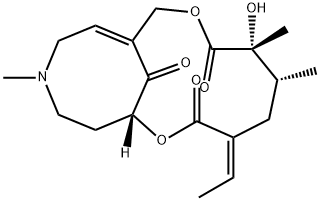
Description
A further hepatotoxiC alkaloid present in Senecio kirkii Hook, S. renardi and Nardosrnia laevigata. The base has [α]
25D - 16° (c 1.89, MeOH) or[α]
15D - 6.2° (c 1.91, CHCI
3). It forms colourless plates when crystallized from either Me
2CO or AcOEt and yields a picrate, m.p. 225.5-226°C and a picrolonate, m.p. 109- 110°C. The ultraviolet spectrum shows a single absorption maximum at 219 mp.. Several crystalline salts and derivatives are known, e.g. the aurichloride, m.p. 182.5-183.5°C; platinichloride, m.p. 196-7°C (dec.); bitartrate, m.p. 201°C; reineckate, m.p. 169-171°C; picrate, m.p. 225- 225.5°C; picrolonate, m.p. 138°C and the methiodide, m.p. 194-6°C (dec.). The O-acetate occurs naturally (q.v.) in Senecio kirkii.
Uses
Senkirkin, a pyrrolizidine alkaloid, occured in the aerial parts of the medicinal plant Tussilago farfara, could induce chromosome damage in human lymphocytes. Senkirkin can be metabolized by CYP3A4[1].
Definition
ChEBI: Senkirkine is a macrolide.
Safety Profile
Poison by ingestion and
intraperitoneal routes. Questionable
carcinogen with experimental neoplastigenic
data. Mutation data reported. When heated
to decomposition it emits toxic fumes of
Nox
References
Briggs, Mangan, Russell., J. Chern. Soc., 1891 (1948)
Massagetov, Kuzovkov.,J. Gen. Chern., USSR, 23, 158 (1953)
Danilova, Konovalova., ibid, 30, 1921 (1961)
Danilova, Koretskaya, Utkin., ibid, 31, 3815 (1961)
Wunderlich., Chern. Ind., 2089 (1962)
Briggs et al., J. Chern. Soc., 2492 (1965)