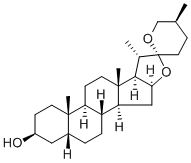
Sarsasapogenin (20 and 40 mg/kg) significantly restores the sucrose preference deficit induced by olfactory bulbectomy (OB), and increases locomotor activity. Sarsasapogenin groups (20 and 40 mg/kg) have significantly lower immobility times, higher AChE protein expression levels than the OB group. Furthermore, Sarsasapogenin (20 and 40 mg/kg) groups have significantly higher α7-nAChR protein expression, and increases higher α4-nAChR protein expression levels compared to rats in the OB group[2]. Sarsasapogenin (5 or 10 mg/kg, p.o.) inhibits TNBS-induced colon shortening and myeloperoxidase activity in mice, reducing NF-κB activation and interleukin (IL)-1β, tumor necrosis factor (TNF)-α, and IL-6 levels, while simultaneously increasing IL-10[3].