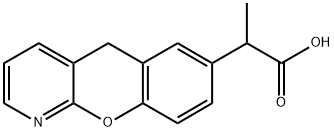
Preparation
Using 2-chloronicotinic acid as a raw material, it is condensed with phenol under a strongly alkaline environment, then dehydrated by polyphosphoric acid, reduced by potassium borohydride, then hydrolyzed in acid, and finally acylated with chloroacetyl chloride. After hydrolysis under alkaline conditions, it is acylated by sulfonyl chloride and finally rearranged to obtain pranoprofen.
Chemical Properties
Off-White Solid
Originator
Niflan, Yoshitomi ,Japan ,1981
Uses
Pranoprofen is an anti-inflammatory used in ophthalmology.
Definition
ChEBI: Pranoprofen is a pyridochromene.
Manufacturing Process
A mixture of 100 g of ethyl 2-cyano-2-(5H-[1]benzopyrano[2,3-b]-pyridin-7yl)propionate, 500 ml of glacial acetic acid and 200 g of concentrated hydrochloric acid is refluxed for 48 hours. The reaction mixture is concentrated, and the residue is dissolved in hot water. The solution is adjusted to pH 2 to 3 by addition of 10% sodium hydroxide. The resulting crystalline precipitate is washed thoroughly with water, and recrystallized from aqueous dioxane to give 74 g of 2-(5H-[1]benzopyrano[2,3-b]-pyridin-7yl)propionic acid as white crystals melting at 183°C to 183.5°C.
Therapeutic Function
Analgesic, Antiinflammatory
General Description
Pranoprofen is an arylalkanoic acid and a non-steroidal anti-inflammatory drug.
Biochem/physiol Actions
Pranoprofen is used in eyes to treat chronic allergic conjunctivitis. It is also used as an anti-inflammatory and analgesic drug after strabismus surgery.