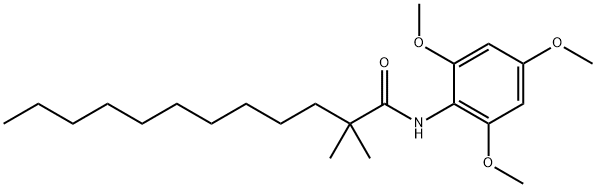
Description
Acyl-coenzyme A:cholesterol acyltransferase 1 (ACAT-1) is a sterol
O-acyltransferase that catalyzes the formation of fatty acid-cholesterol esters, an important step in lipoprotein assembly and dietary cholesterol absorption. CI-976 is a potent, selective inhibitor of ACAT-1 (IC
50 = 73 nM). It is orally bioavailable and decreases plasma total cholesterol, very low density lipoprotein (VLDL) cholesterol, LDL cholesterol, apolipoprotein B, liver cholesteryl esters, and VLDL and LDL cholesteryl ester content in rabbits given a diet that induces hypercholesterolemia. CI-976 also diminishes atherosclerotic activity in hypercholesterolemic rabbits.
Uses
CI 976 has been used as an acyl-coenzyme A: cholesterol acyltransferase (ACAT) inhibitor:
- to analyze its anti-hepatitis C virus (HCV) activity in Huh7.5.1 cells
- to treat Neuro-2a cells to test its effect on plasma membrane integrated density of α4-SEPβ2 or α6-SEPβ2β3 nicotinic acetylcholine receptors (nAChRs)
- to study its effects on the anti-angiogenic activity of pyripyropenes in human umbilical vein endothelial cells
Uses
CI-976 (2,2-Dimethyl-N-(2,4,6-trimethoxyphenyl)dodecanamide) is a selective inhibitor of Acyl-coenzyme A: cholesterol Acyltransferase 1 (ACAT-1), a sterol O-acetyltransferase that catalyzes information of fatty acid-cholesterol esters. Orally bioavailable and decreses plasma total cholesterol
Definition
ChEBI: 2,2-dimethyl-N-(2,4,6-trimethoxyphenyl)dodecanamide is an anilide.
Biological Activity
Selective acyl-coenzyme A:cholesterol acyltransferase (ACAT) inhibitor (IC 50 = 0.073 μ M). Lowers non-high density lipoprotein (HDL)-cholesterol and increases HDL-cholesterol concentrations in rats with pre-established dyslipidaemia. Orally active.
Biochem/physiol Actions
CI-976 (2,2-Dimethyl-N-(2,4,6-trimethoxyphenyl)dodecanamide), a new trimethoxy fatty acid anilide, is a potent and specific inhibitor of liver and intestinal acyl coenzyme A; cholesterol acyltransferase (ACAT) in vitro. CI-976 decreased non-high density lipoprotein (HDL)-cholesterol and increased HDL-cholesterol in rats with pre-established dyslipidemia. High performance gel chromatographic separation of plasma lipoproteins also revealed that CI-976, but not CL 277,082, lowered low density lipoprotein (LDL)-cholesterol and elevated HDL-cholesterol.
References
[1] K. BUHMAN R V F H Chen. The Enzymes of Neutral Lipid Synthesis*[J]. The Journal of Biological Chemistry, 2001, 34 1: 40369-40372. DOI:
10.1074/jbc.r100050200[2] YUGUANG SHI Paul B. Lipid metabolic enzymes: emerging drug targets for the treatment of obesity[J]. Nature Reviews. Drug Discovery, 2004, 3 8: 695-710. DOI:
10.1038/nrd1469[3] F. JEFFREY FIELD Satya M Ella Albright. Inhibition of acylcoenzyme A:Cholesterol acyltransferase activity by PD128O42: Effect on cholesterol metabolism and secretion in CaCo-2 cells[J]. Lipids, 1991, 26 1: 1-8. DOI:
10.1007/bf02544016[4] PATRICK M. O’BRIEN. Inhibitors of Acyl-CoA:Cholesterol O-Acyl Transferase (ACAT) as Hypocholesterolemic Agents. 8. Incorporation of Amide or Amine Functionalities into a Series of Disubstituted Ureas and Carbamates. Effects on ACAT Inhibition in vitro and Efficacy in vivo[J]. Journal of Medicinal Chemistry, 1994, 37 12: 1810-1822. DOI:
10.1021/jm00038a010[5] B R KRAUSE. ACAT inhibition decreases LDL cholesterol in rabbits fed a cholesterol-free diet. Marked changes in LDL cholesterol without changes in LDL receptor mRNA abundance.[J]. Arteriosclerosis and thrombosis: a journal of vascular biology, 1994, 14 4: 598-604. DOI:
10.1161/01.atv.14.4.598[6] T M BOCAN. Comparison of CI-976, an ACAT inhibitor, and selected lipid-lowering agents for antiatherosclerotic activity in iliac-femoral and thoracic aortic lesions. A biochemical, morphological, and morphometric evaluation.[J]. Arteriosclerosis and thrombosis: a journal of vascular biology, 1991, 11 6: 1830-1843. DOI:
10.1161/01.atv.11.6.1830