Chemical Properties
Light yellow liquid
Chemical Properties
Colorless to pale yellow liquid; meat-like aroma
Occurrence
Reported found in beef, cranberry, mushroom and turkey.
Uses
2-n-Hexylthiophene is used as a important raw material and intermediate used in organic synthesis, pharmaceuticals, agrochemicals.
Definition
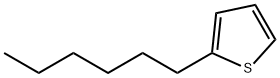
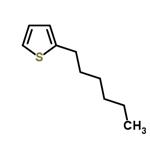
ChEBI: 2-Hexylthiophene is a heteroarene.
Aroma threshold values
High strength odor, sulfurous type; recommend smelling in a 0.10% solution or less
Synthesis
To a solution of thiophene (5.0 g, 60 mmol) in tetrahydrofuran (THF, 50 mL) was added slowly and dropwise n-butyllithium (n-BuLi, 40.6 mL, 65 mmol, 1.6 M hexane solution) at -78 °C and under nitrogen protection. The reaction mixture was stirred at -78 °C for 1 hour. Subsequently, 1-bromohexane (10.7 g, 65 mmol) was slowly added to the reaction system and the reaction mixture was gradually warmed to room temperature and stirring was continued for 12 hours. After completion of the reaction, the reaction was quenched with water and the product was extracted with ether. The organic phase was washed sequentially with water and saturated saline, dried over anhydrous magnesium sulfate (MgSO4) and concentrated under reduced pressure. The crude product was purified by rapid column chromatography on silica gel, using hexane as eluent, to give 2-hexylthiophene (2a) as a colorless liquid. Yield: 8.3 g (82% yield). The product was characterized as follows: IR (KBr, cm-1): 3071 (sp2 C-H stretching vibration), 2921-2854 (sp3 C-H stretching vibration), 1470 (C=C stretching vibration); 1H NMR (300 MHz, CDCl3, δ/ppm): 7.08 (d, 1H, J=4.8Hz), 6.88 (dd, 1H J=4.8Hz), 6.69 (d, 1H, J=3.3Hz), 2.81 (t, 2H, J=7.7Hz), 1.68-1.61 (m, 2H), 1.34-1.26 (m, 6H), 1.02-0.98 (t, 3H, J=1.8Hz); EIMS m/z (relative abundance): 168 (100, M+).
References
[1] Organic Letters, 2002, vol. 4, # 12, p. 2067 - 2070
[2] Journal of Organic Chemistry, 2009, vol. 74, # 7, p. 2718 - 2725
[3] Inorganic Chemistry, 2018, vol. 57, # 3, p. 1527 - 1534
[4] Chinese Chemical Letters, 2011, vol. 22, # 7, p. 819 - 822
[5] Bulletin of the Korean Chemical Society, 2012, vol. 33, # 11, p. 3810 - 3816