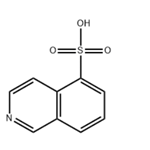
Synthesis
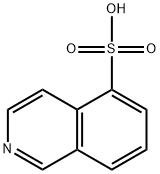
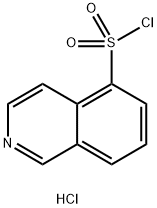
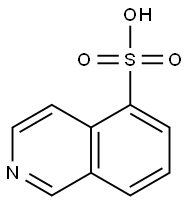
The general procedure for the synthesis of 5-isoquinolinesulfonic acid from isoquinoline-5-sulfonyl chloride hydrochloride was as follows: the synthesis of compound 3i was carried out according to the method reported in the literature [56,57]. The procedure was as follows: 5-isoquinolinesulfonic acid (2.10 g, 10 mmol), 25 mL of thionyl chloride, and 1 mL of dimethylformamide were added to a 100 mL round-bottomed flask, and the mixture was refluxed for 1 hour. Upon completion of the reaction, the remaining thionyl chloride was removed by rotary evaporation, and the residue was suspended in dichloromethane, filtered, and washed with dichloromethane (2 x 25 mL). The precipitate was collected and dried under vacuum to give the crude isoquinoline-5-sulfinyl chloride hydrochloride in 85% yield (2.25 g). Next, isoquinoline-5-sulfonyl chloride hydrochloride (2.0 g, 7.6 mmol) and 20 mL of ice-cold deionized water were added to another 100 mL round bottom flask. The mixture was slowly added to an equimolar amount of sodium bicarbonate (0.64 g) and the resulting solution was extracted twice with dichloromethane (2 x 20 mL). The organic layers were combined, dried with anhydrous sodium sulfate, and then added dropwise to 25 mL of dichloromethane solution containing ethylenediamine (1.37 g, 22.8 mmol) at 0°C. The reaction was continued with stirring at room temperature for 1 h. The reaction was subsequently washed with deionized water to remove excess ethylenediamine and finally the solvent was evaporated. The residue was recrystallized from ethanol to give pure compound 3i in 55% yield.
References
[1] Bioorganic and Medicinal Chemistry, 2013, vol. 21, # 18, p. 5694 - 5706