Description
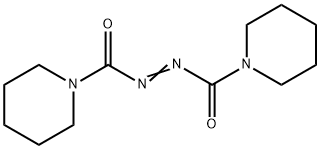
1,1''-(Azodicarbonyl)dipiperidine (ADDP) is a reagent commonly used in the Mitsunobu reaction for the condensation of an alcohol and an acidic compound. It has been used as a reagent in the synthesis of G protein-coupled receptor 120 (GPR120) agonists with antidiabetic activity and peroxisome proliferator-activated receptor α (PPARα), PPARγ, and PPARδ triple agonists.
Chemical Properties
yellow crystalline powder
Uses
It is used in a study of the copper-catalyzed addition of aryboronic acids to azodicarboxyl derivatives providing aryl-substituted hydrazides. It is widely used reagent for the Mitsunobu reaction. It is reactant for preparation of polyfluoroalkylated tripyrazolylmethane ligands, (-)-Hygromycin A via Mitsunobu glycosylation, optically active α,α-disubstituted amino acids via Mitsunobu reaction, aza-β-lactams through [2+2] cycloaddition reactions, glycosyl disulfides, pyridine ether PPAR agonists, S-glycosyl amino acid, building blocks for combinatorial neoglycopeptide synthesis and is a histamine H3 receptor antagonists. It is a reactant for Mitsunobu inversion reactions.
Reactions
1,1'-(Azodicarbonyl)-dipiperidine can selectively oxidizes a variety of alcohols to the corresponding aldehydes or ketones under basic conditions.
IC 50
PPARα; PPAR-γ; PPARδ
References
[1] TETSUTO TSUNODA Sh I Yoshiko Yamamiya. 1,1′-(azodicarbonyl)dipiperidine-tributylphosphine, a new reagent system for mitsunobu reaction[J]. Tetrahedron Letters, 1993, 34 10: Pages 1639-1642. DOI:
10.1016/0040-4039(93)85029-v[2] DAISUKE HIROSE. Systematic Evaluation of 2-Arylazocarboxylates and 2-Arylazocarboxamides as Mitsunobu Reagents[J]. The Journal of Organic Chemistry, 2018, 83 8: 4712-4729. DOI:
10.1021/acs.joc.8b00486[3] XUQING ZHANG . Design, synthesis and SAR of a novel series of heterocyclic phenylpropanoic acids as GPR120 agonists[J]. Bioorganic & Medicinal Chemistry Letters, 2017, 27 15: Pages 3272-3278. DOI:
10.1016/j.bmcl.2017.06.028[4] JOHN P MOGENSEN. Design and synthesis of novel PPARα/γ/δ triple activators using a known PPARα/γ dual activator as structural template[J]. Bioorganic & Medicinal Chemistry Letters, 2003, 13 2: Pages 257-260. DOI:
10.1016/s0960-894x(02)00881-8