Chemical Properties
It is soluble in organic solvents such as methanol, ethanol, and DMSO, and is derived from Ginkgo biloba.
Uses
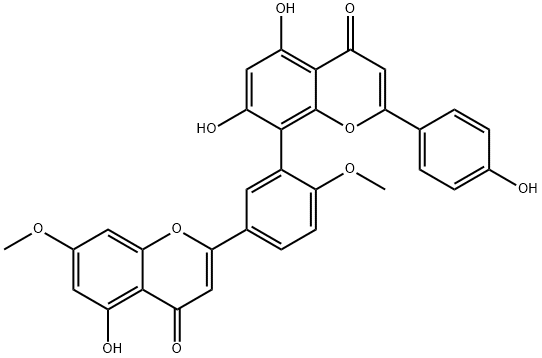
Ginkgetin, a biflavone, is isolated from Ginkgo biloba leaves. Ginkgetin exhibit anti-tumor, anti-inflammatory, neuroprotective, anti-fungal activities. Ginkgetin is also a potent inhibitor of Wnt signaling, with an IC50 of 5.92 μΜ[1][2][3][4][5].
Definition
ChEBI: A biflavonoid that is the 7,4'-dimethyl ether derivative of amentoflavone. Isolated from Ginkgo biloba and Dioon, it exhibits anti-HSV-1, antineoplastic and inhibitory activities towards arachidonate 5-lipoxygenase and cyclooxyge
ase 2.
References
[1] Hu WH, et, al. Synergy of Ginkgetin and Resveratrol in Suppressing VEGF-Induced Angiogenesis: A Therapy in Treating Colorectal Cancer. Cancers (Basel). 2019 Nov 20;11(12):1828. DOI:
10.3390/cancers11121828[2] Ye ZN, et, al. Biflavone Ginkgetin, a Novel Wnt Inhibitor, Suppresses the Growth of Medulloblastoma. Nat Prod Bioprospect. 2015 Mar 29;5(2):91-97. DOI:
10.1007/s13659-015-0056-4[3] Xiong M, et, al. Ginkgetin exerts growth inhibitory and apoptotic effects on osteosarcoma cells through inhibition of STAT3 and activation of caspase-3/9. Oncol Rep. 2016 Feb;35(2):1034-40. DOI:
10.3892/or.2015.4427[4] Li Q, et, al. Ginkgetin exerts anti-inflammatory effects on cerebral ischemia/reperfusion-induced injury in a rat model via the TLR4/NF-κB signaling pathway. Biosci Biotechnol Biochem. 2019 Apr;83(4):675-683. DOI:
10.1080/09168451.2018.1553608[5] Lou J, et, al. Ginkgetin induces autophagic cell death through p62/SQSTM1-mediated autolysosome formation and redox setting in non-small cell lung cancer. Oncotarget. 2017 Oct 16;8(54):93131-93148. DOI:
10.18632/oncotarget.21862