Uses
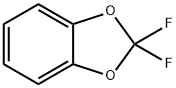
2,2-Difluoro-1,3-benzodioxole is an intermediate compound which is used especially for the preparation of products for agricultural chemistry and for the synthesis of pharmaceutical products.
2,2-difluoro-1,3-benzodioxole is a useful difluoromethylated building block for the synthesis of various benzodioxole-containing pharmaceutical active compounds.
2-,3-,and 4-(Trifluoromethoxy)phenyllithiums: Versatile intermediates offering access to a variety of new organofluorine compounds.
Selective aliphatic fluorination by halogen exchange in mild conditions.
Preparation
2,2-Difluoro-1,3-benzodioxole is prepared by reaction of 2,2-dichloro-1,3-benzodioxole with potassium fluoride in the presence of an effective quantity of a catalyst selected from potassium hydrogen fluoride, sodium hydrogen fluoride, cesium hydrogen fluoride, rubidium hydrogen fluoride, and quaternary ammonium hydrogen fluoride.
https://patents.google.com/patent/US5432290A/en
References
[1] E.Castagnetti, et al, Eur. J. Org. Chem., 2001, 2001(4), pp 691-695.
[2] L.Saint-Jalmes, J. F. Chem., 2006, 127(1), pp 85-90.
Chemical Properties
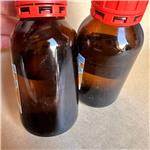
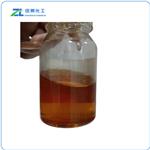
Colorless to pale yellow liquid
Uses
2,2-Difluoro-1,3-benzodioxole is used in the synthesis of Kv3 inhibitors as well as in the preparation of renin inhibitors.
Synthesis
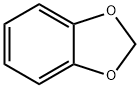
The general procedure for synthesizing 2,2-difluoro-1,3-benzodioxole from piperylene ring was as follows: first, 100 g of benzodioxole and 900 g of acetonitrile were accurately weighed and mixed to prepare a solution of benzodioxole acetonitrile with a mass fraction of 10%. Subsequently, 1 g of trifluoroacetic acid was added to this solution and mixed thoroughly. Next, a fluorine gas-nitrogen mixture with a mass fraction of 10% was prepared by adjusting the flow rate of fluorine gas and nitrogen gas. The reaction process shown in FIG. 1 was employed, using a microchannel reactor made of silicon carbide. The liquid volume of each module was set to 1 ml and the reaction temperature was controlled at -20 °C. The reaction residence time was controlled by adjusting the pumping rate to 20 s. In module A, a 10% mass fraction benzodioxole acetonitrile solution containing 1% trifluoroacetic acid was continuously pumped for pre-cooling. At the same time, a 10% mass fraction fluorine gas mixture was continuously and uniformly passed into the B module, in which the molar amount of fluorine gas was 2.2 times that of benzodioxole. After the reactants were mixed and reacted in the CDEF module, they entered a gas-liquid separator for separation. The separated gas was treated and discharged, while the liquid was washed and distilled, resulting in 1,3-benzodioxole-2,2-difluorine product with 90% yield and 99% content.
Synthesis
First, a difluoromethylenedioxy ring is directly constructed by a nucleophilic substitution reaction of catechol and dibromodifluoromethane under alkaline conditions; or a two-step method is used, firstly, 1,3-benzodioxane is photochlorinated to obtain 2,2-dichloro-1,3-benzodioxane, and then a halogen exchange reaction is carried out in the presence of anhydrous hydrogen fluoride (HF) or fluorinating agents such as sodium fluoride/potassium fluoride to replace chlorine atoms with fluorine atoms, thereby obtaining the target product 2,2-Difluoro-1,3-benzodioxole.
References
[1] Patent: CN108383825, 2018, A. Location in patent: Paragraph 0020-0039; 0044-0047