Uses
A novel, ATP competitive inhibitor of Pim1, Pim2 and Pim3 with IC50s of 7 nM, 363 nM and 69 nM, respectively.
Uses
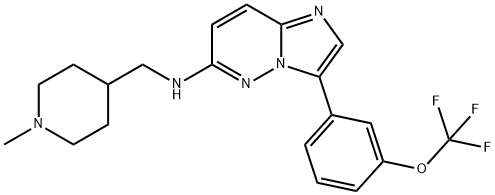
SGI-1776 is a Pim-1 kinase inhibitor. Potent PIM inhibitor.
Definition
ChEBI: N-[(1-methyl-4-piperidinyl)methyl]-3-[3-(trifluoromethoxy)phenyl]-6-imidazo[1,2-b]pyridazinamine is a member of imidazoles.
Biological Activity
sgi-1776 free base, n-((1-methylpiperidin-4-yl)methyl)-3-(3-(trifluoromethoxy)phenyl)imidazo[1,2-b]pyridazin-6-amine, is a potent atp-competitive inhibitor of the serine/threonine family of pim kinase, an enzyme regulating cell survival. through extensive biomedical characterization, sgi-1776 exhibits specificity to the three isoforms of the pim family, including pim-1, pim-2, and pim-3. according to preliminary results from studies treating prostate cancer cells, sgi-1776 dose-dependently reduces phosphorylation of known pim kinase substrates involved in cell cycle progression and apotosis (p21cip1/waf1 and bad), compromises overall cell viability by inducing g1 cell cycle arrest and triggering apoptosis, and reduces cell viability in a multidrug resistance 1 (mdr1) protein based taxane-refractory prostate cancer cell line.shannon m. mumenthaler, patricia y.b. ng, amanda hodge, davide bearss, gregory berk, sarath kanekal, sanjeev redkar, pietro taverna, davide b. agus, and anjali jain. pharmacological inhibition of pim kinases alters prostate cancer cell growth and resensitizes chemoresistant cells to taxanes. mol cancer ther. 2009; 8(10): 2882-2893lisa s. chen, s anjeev redkar, david bearss, william g. wierda and varsha gandhi. pim kinase inhibitor, sgi-1776, induces apoptosis in cll lymphocytes. blood. 2009; 114(19): 4150-4157
Synthesis
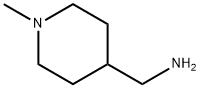
12. Scheme for the synthesis of 7-29. Scheme 6: 13. Synthesis of N-((1-methylpiperidin-4-yl)methyl)-3-(3-(trifluoromethoxy)phenyl)imidazo[1,2-b]pyridazin-6-amine (Compound 7-29):[0148] Under the protection of argon, 6-chloro-3-(3-(trifluoromethoxy)phenyl)imidazo[1,2-b]pyridazinium (40 mg, 0.128 mmol ), (1-methylpiperidin-4-yl)methylamine (24.53 mg, 0.191 mmol), ligand (7.53 mg, 0.019 mmol), Pd2(dba)3 (9.56 mg, 0.010 mmol) and NaOtBu (17.40 mg, 0.181 mmol) were dissolved in toluene (5 mL). The reaction mixture was degassed for 10 minutes and then heated to reflux for 12 hours. Upon completion of the reaction, the crude product was concentrated and purified by preparative thin layer chromatography (TLC) using 10% MeOH/DCM as eluent to give 17.6 mg of the target product 7-29 in 50% yield.
in vivo
SGI-1776 free base (75, 200 mg/kg, p.o.) shows potent and sustained antitumor activity in a dose dependent manner in MV-4-11 xenografts in mice[4].
References
[1] Patent: WO2008/58126, 2008, A2. Location in patent: Page/Page column 54-55


![IMIDAZO[1,2-B]PYRIDAZINE, 6-CHLORO-3-[3-(TRIFLUOROMETHOXY)PHENYL]-](/CAS/20180702/GIF/928337-00-2.gif)