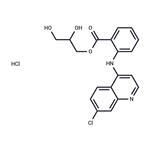
Glafenine injection (25 mg/kg i.v.) shows enhanced BLI signal in mice with an average of 2.9-fold signal enhancement over the control. Glafenine causes increases in BLI signal of up to 11.6- and 17.4-fold in two separate HEK293/ABCG2/fLuc xenografts in the same mouse compared to the signals generated by those xenografts immediately before injection[1]. Incubating polarized CFBE41o- monolayers and intestines isolated from mutant CFTR mice with glafenine increases the short-circuit current response to forskolin and genistein. Treatment with glafenine also partially restores total salivary secretion[2]. Glafenine-treated zebrafish shows evidence of endoplasmic reticulum and mitochondrial stress, with disrupted intestinal architecture and halted cell stress responses, alongside accumulation of apoptotic intestinal epithelial cells in the lumen[4].

![1-Glyceryl N-[7-chloro-4-quinolyl]anthranilate hydrochloride Structure](https://www.chemicalbook.com/CAS/GIF/65513-72-6.gif)