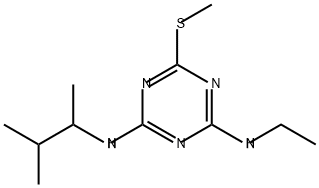
Description
Dimethametryn is a rice herbicide. It has a moderate aqueous solubility and, based on its chemical properties, it only slightly mobile and would not be expected to leach to groundwater. It tends to be persistent in soil systems and may also persist in aqueous systems. It is not susceptible to hydrolysis. It has a low mammalian toxicity and is a recognised irritant. It is moderately toxic to fish, aquatic invertebrates and honeybees.
Uses
Dimethametryn is a pesticide.
Production Methods
Dimethametryn is synthesised through a multi-step process that constructs its alkylthiotriazine core, a structure key to its herbicidal activity. The production typically begins with the formation of a 1,3,5-triazine ring, using precursors such as cyanuric chloride or related triazine intermediates. This ring is then selectively substituted at the nitrogen positions with ethylamine and a branched alkylamine, such as 1,2-dimethylpropylamine, to introduce the desired side chains. A methylthio group is added at the 6-position via nucleophilic substitution using methyl mercaptan or a similar sulphur donor.
Definition
ChEBI: Dimethametryn is a member of 1,3,5-triazines.
Mechanism of action
Selective, absorbed by roots and foliage. Inhibits photosynthesis (photosystem II).
Safety Profile
Moderately toxic by ingestion andskin contact. When heated to decomposition it emits toxicvapors of NOx and SOx.