Chemical Properties
White crystals or powder
Uses
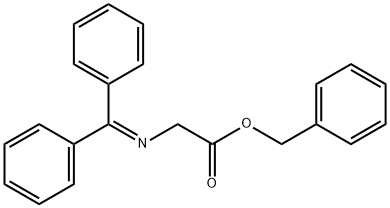
N-(Diphenylmethylene)glycine benzyl ester is used as a reagent to synthesize (-)-Lepadiformine, a marine cytotoxic alkaloid that exhibits activity towards lunch carcinoma cell lines. N-(Diphenylmethylene)glycine benzyl ester is also used as a reagent to prepare (+)-Cylindricine C, a marine alkaloid that also shows activity against tumour cell lines.
Synthesis
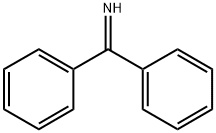
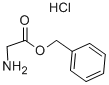
A 3-necked 5L round bottom flask was equipped with a mechanical stirrer, a J-KEM temperature probe and an N2 inlet adapter connected to a bubbler. Glycine benzyl ester hydrochloride (505.2 g, 2.51 mol, 1.0 eq.) and dichloromethane (3.0 L) were added to the flask. Benzophenone imine (471.1 g, 97% purity, 2.6 mol, 1.00 eq.) was subsequently added to the milky reaction mixture and the reaction was observed to be exothermic (temperature rise of 4.5 °C). The reaction mixture was stirred at 20 °C for 3 h. Detection by TLC (unfolding agent: 50% ethyl acetate/heptane) showed only trace residues of starting material. After addition of benzophenone imine (25.0 g, 0.14 mol), stirring was continued at 20 °C for 15 h. TLC confirmed the completion of the reaction. The reaction mixture was filtered through a short diatomaceous earth pad to remove the ammonium chloride generated and the filter cake was washed with dichloromethane (1.5 L). After combining the filtrates, it was concentrated under reduced pressure to give a white solid, which was further dried under vacuum to obtain the crude product N-diphenylmethylene glycine benzyl ester 878.7 g (106% yield). The product was identified by 1H-NMR (DMSO-d6): δ 7.53-7.25 (m, 13H), 7.12 (dd, 2H), 5.10 (s, 2H) and 4.17 (s, 2H). HPLC analysis showed purity >95%.
References
[1] Patent: US2005/239857, 2005, A1. Location in patent: Page/Page column 82
[2] Patent: WO2007/49121, 2007, A1. Location in patent: Page/Page column 15
[3] Bioorganic and Medicinal Chemistry Letters, 2011, vol. 21, # 9, p. 2725 - 2731
[4] Patent: US2005/239857, 2005, A1. Location in patent: Page/Page column 33
[5] Organic Process Research and Development, 2008, vol. 12, # 6, p. 1183 - 1187