Chemical Properties
White to yellow solid
Uses
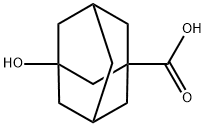
3-Hydroxy-1-AdaMantane Carboxylic Acid is used in the synthesis of potent pyridyl amide/sulfonamide inhibitors of 11β-HSD-1 which could be applied to a treatment of ulcers or in hormone therapy treatments relating t o cortisol.
Uses
1-Carboxy-3-adamantanol is used in the synthesis of potent pyridyl amide/sulfonamide inhibitors of 11β-HSD-1 which could be applied to a treatment of ulcers or in hormone therapy treatments relating to cortisol.
Synthesis
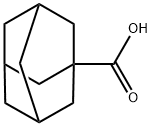
The general procedure for the synthesis of 3-hydroxyadamantane from 1-adamantanecarboxylic acid was as follows: 30.2 g of 1-adamantanol (99% purity) was added to a glass reaction flask equipped with a stirrer, a thermometer, a dropping funnel, and a Dimroth condenser, followed by the addition of 215.2 g of 96% concentrated sulfuric acid. After stirring at room temperature until the ingredients were completely dissolved, 9.3 g of formic acid was slowly added dropwise over a period of 15 minutes and the temperature of the reaction solution was maintained between 10 and 20 °C by external cooling. After the dropwise addition, the reaction temperature was raised to 35 °C for 3 hours. The progress of the reaction was monitored by gas chromatography (GC) and 1-adamantanecarboxylic acid was produced when the conversion of 1-adamantanol reached 100%. Subsequently, 23.1 g of 70% nitric acid was slowly added dropwise over a period of 30 min under continued cooling conditions, maintaining the temperature of the reaction solution in the range of 10 to 20 °C. After completion of the dropwise addition, the reaction temperature was maintained at 35 °C for 3 hours to continue the reaction. After confirming the complete conversion of 1-adamantanecarboxylic acid to 3-hydroxyadamantane-1-carboxylic acid by GC, the subsequent purification step was carried out.
Purification step: in another glass flask equipped with a stirrer and a thermometer, a mixed solution of sodium hydroxide and sodium sulfite was prepared by adding 90.2 g of sodium hydroxide, 35.5 g of sodium sulfite and 812 g of ion-exchanged water, and the flask was cooled. 277.8 g of reaction solution containing 3-hydroxy-1-adamantanecarboxylic acid was slowly added to the above mixed solution, and the temperature of the liquid was controlled not to exceed 40 ℃. The precipitated white crystals were separated by filtration and washed with deionized water. The resulting crystals were dried under reduced pressure at 40 °C for 8 h. Finally, 35.8 g (92.6% yield) of white crystals of 3-hydroxyadamantane-1-carboxylic acid were obtained. The content of high boiling point by-products (high molecular weight by-products) in the crystals was 1.28% as analyzed by gel permeation chromatography-refractive index detector (GPC-RI).
References
[1] Journal of Medicinal Chemistry, 2018, vol. 61, # 1, p. 98 - 118
[2] Patent: JP2016/84315, 2016, A. Location in patent: Paragraph 0043-0045
[3] Letters in Organic Chemistry, 2016, vol. 13, # 7, p. 514 - 518
[4] Journal of Organic Chemistry USSR (English Translation), 1992, vol. 28, # 10, p. 1680 - 1683
[5] Zhurnal Organicheskoi Khimii, 1992, vol. 28, # 10, p. 2098 - 2102