Chemical Properties
PALE BROWN-ORANGE TO PALE BROWN POWDER
Uses
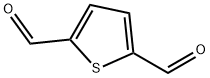
2,5-Thiophenedicarboxaldehyde may be employed in the following studies:
- Asymmetric synthesis of bis-homoallylic alcohols.
- Synthesis of new symmetrical arylene bisimide derivatives.
- As dialdehyde monomer in the synthesis of silicon-containing poly(p-phenylenevinylene)-related copolymers having uniform p-conjugated segment regulated by organosilicon units.
- Synthesis of 2,5-bis[2-(5-N-isopropylamidino)benzimidazoyl]thiophene hydrochloride.
Uses
2,5-Thiophenedicarboxaldehyde acts as a reagent in the synthesis of N,N''-bis-(mercaptophenylimine)thiophenedicarboxaldehyde Schiff base, and also functions as an intermediate in many organic synthesis.
General Description
2,5-Thiophenedicarboxaldehyde can be prepared from 2,5-bis(chloromethyl)thiophene by the application of Krhnke′s method.
Synthesis
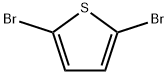
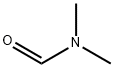
General method: n-Butyllithium solution (2.5 M hexane solution, 0.91 ml, 2.28 mmol, 1.1 eq.) was slowly added to a solution of 2,5-dibromothiophene (3a, 0.5 g, 2.07 mmol) in tetrahydrofuran (THF, 20 ml) under argon protection and at -78°C. The reaction mixture was slowly warmed to 0°C over 30 min. Subsequently, anhydrous N,N-dimethylformamide (DMF, 182 mg, 2.48 mmol, 1.2 eq.) was added and the reaction mixture was stirred at room temperature for 2 hours. Tert-butyl lithium solution (1.7 M pentane solution, 1.58 ml, 2.69 mmol, 1.3 eq.) was added again at -78 °C and the reaction mixture was stirred for 5 min. Next, an excess of anhydrous N,N-dimethylformamide (1 ml) was added and the reaction mixture was stirred overnight at room temperature. After completion of the reaction, the solution was poured into 1N hydrochloric acid (HCl, 10 ml) and stirred for 20 min. After neutralization with aqueous sodium bicarbonate (NaHCO3), the aqueous phase was extracted with dichloromethane (3 x 30 ml). The organic phases were combined, dried with anhydrous magnesium sulfate (MgSO4) and concentrated under reduced pressure to remove the solvent. The crude product was purified by silica gel column chromatography (eluent: hexane-ethyl acetate, 6:1) to afford 2,5-thiophenedicarboxaldehyde (8a, 123 mg, 42% yield) as a yellow amorphous solid.
References
[1] Chemistry of Materials, 2014, vol. 26, # 24, p. 7229 - 7235
[2] Tetrahedron Letters, 2013, vol. 54, # 22, p. 2795 - 2798
[3] Organic Letters, 2012, vol. 14, # 1, p. 78 - 81
[4] Journal of the American Chemical Society, 1995, vol. 117, # 9, p. 2467 - 2478