Description
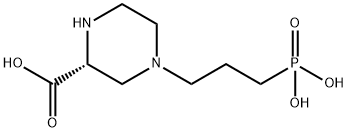
(R)-CPP is an NMDA receptor antagonist (K
i = 0.14 μM). It binds to NMDA receptors containing GluN2A, GluN2B, GluN2C, and GluN2D subunits with K
i values of 0.04, 0.3, 0.6, and 2 μM, respectively. It inhibits depolarization induced by NMDA in isolated hemisected frog spinal cord (pA
2 = 6.56) and NMDA-induced sodium efflux from rat brain slices (pA
2 = 6.2). (R)-CPP inhibits the clonic phase of sound-induced seizures in DBA/2 mice (ED
50 = 65.8 μmol/kg) and the myoclonic phase of stroboscopic-induced seizures in
P. papio photosensitive baboons (ED
50 = 127 μmol/kg).
Uses
(R)-CPP is a piperazine derivative demonstrating highly potent NMDA receptor antagonism.
Biological Activity
Highly potent NMDA antagonist; more active isomer. Shows some selectivity for NR2A-containing receptors (K i values are 0.041, 0.27, 0.63 and 1.99 μ M for inhibition of NR2A-, NR2B-, NR2C- and NR2D-containing recombinant NMDA receptors respectively).
storage
Room temperature (desiccate)
References
[1] B. AEBISCHER. ChemInform Abstract: Synthesis and NMDA Antagonistic Properties of the Enantiomers of 4-(3-Phosphonopropyl)piperazine-2-carboxylic Acid (CPP) and of the Unsaturated Analogue (E)-4-(3-Phosphonoprop-2-enyl)piperazine-2-carboxylic Acid (CPP-ene).[J]. ChemInform, 1989, 20 44. DOI:
10.1002/chin.198944252[2] P. PAOLETTI J. N. NMDA receptor subunits: Function and pharmacology[J]. Acute Pain, 2007, 9 2: Page 97. DOI:
10.1016/j.acpain.2007.04.009[3] SMITA PATEL . Anticonvulsant activity of the NMDA antagonists, d()4-(3-phosphonopropyl)piperazine-2-carboxylic acid (D-CPP) and d()(E)-4-(3-phosphonoprop-2-enyl) piperazine-2-carboxylic acid (D-CPPene) in a rodent and a primate model of reflex epilepsy[J]. Epilepsy Research, 1990, 7 1: Pages 3-10. DOI:
10.1016/0920-1211(90)90049-2