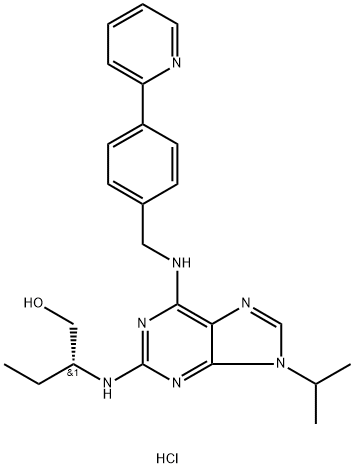
Uses
(R)-CR8 (CR8) trihydrochloride, a second-generation analog of Roscovitine, is a potent CDK1/2/5/7/9 inhibitor. (R)-CR8 trihydrochloride inhibits CDK1/cyclin B (IC50=0.09 μM), CDK2/cyclin A (0.072 μM), CDK2/cyclin E (0.041 μM), CDK5/p25 (0.11 μM), CDK7/cyclin H (1.1 μM), CDK9/cyclin T (0.18 μM) and CK1δ/ε (0.4 μM). (R)-CR8 trihydrochloride induces apoptosis and has neuroprotective effect[1][2]. (R)-CR8 trihydrochloride acts as a molecular glue degrader that depletes cyclin K[3].
in vivo
(R)-CR8 trihydrochloride (5mg/Kg; i.p.) results in a significant reduction in lesion size at 28 days in histological assessment[2].
| Animal Model: | Adult (10 to 12 weeks old) male Sprague-Dawley rats (310 to 330g)[2] |
| Dosage: | 5mg/Kg |
| Administration: | i.p. |
| Result: | Resulted in a significant reduction in lesion size. |
IC 50
CDK1/cyclinB1: 0.09 μM (IC
50); cdk2/cyclin A: 0.072 μM (IC
50); CDK2/cyclinE: 0.041 μM (IC
50); Cdk5/p25: 0.11 μM (IC
50); CDK7/cyclin H: 1.1 μM (IC
50); CDK9/Cyclin T: 0.18 μM (IC
50); CK1δ/ε: 0.4 μM (IC
50)
References
[1] Bettayeb K, et al. CR8, a potent and selective, roscovitine-derived inhibitor of cyclin-dependent kinases. Oncogene. 2008 Oct 2;27(44):5797-807. DOI:
10.1038/onc.2008.191[2] Kabadi SV, et al. CR8, a novel inhibitor of CDK, limits microglial activation, astrocytosis, neuronal loss, and neurologic dysfunction after experimental traumatic brain injury. J Cereb Blood Flow Metab. 2014 Mar;34(3):502-13. DOI:
10.1038/jcbfm.2013.228[3] Sabicki M, et al. The CDK inhibitor CR8 acts as a molecular glue degrader that depletes cyclin K [published online ahead of print, 2020 Jun 3]. Nature. 2020;10.1038/s41586-020-2374-x. DOI:
10.1038/s41586-020-2374-x