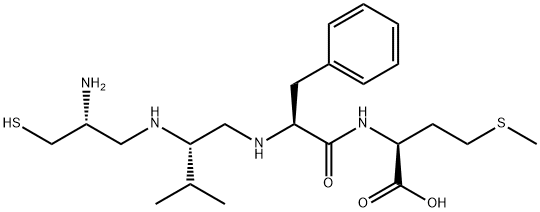
Description
FTase inhibitor I is a potent inhibitor of farnesyltransferase (FTase; IC
50 = 21 nM) that is greater than 30-fold selective for FTase over geranylgeranyl transferase (GGTase; IC
50 = 790 nM). It prevents farnesylation of Ras and inhibits proliferation of cells transformed by Ras farnesylation. In a dog model of subarachnoid hemorrhage, it reduces GTP-Ras in spastic basilar arteries, decreases angiographic vasospasm, and improves clinical scores.
Uses
FTase Inhibitor I is a potent, selective, peptidomimetic FTase inhibitor.
Definition
ChEBI: A dipeptide obtained from the tetrapeptide Cys-Val-Phe-Met by reduction of the amide carbonyl groups of the Cys and Val residues.
Enzyme inhibitor
This cell-permeable CAAX peptidomimetic (FW = 470.70 g/mol; FWtrifluoracetate-salt = 583.71 g/mol; CAS 149759-96-6), named as N-[2(S)- (2(R)-2-amino-3-mercaptopropylamino)-3-methylbutyl]-L-phenylalanyl-L methionine), binds to and prevents protein farnesyltransferase (IC50 = 21 nM) from interacting with C-terminal L-Cys-L-Val-L-Phe-L-Met substrate recognition sequences that are present in its natural substrates. Otherwise hydrophilic proteins associate with membranes by means of enzymatic attachment of hydrophobic moieties to their C-termini. Whereas prenylation occurs in the cytosol, post-prenylation processing is accomplished on the cytoplasmic surface of the endoplasmic reticulum and Golgi apparatus. B581 inhibits prenylation and processing of H-ras and lamin A. B581 specifically blocks farnesylated, but not geranylgeranylated or myristylated, oncogenic ras signaling and transformation.
References
[1] A M GARCIA. Peptidomimetic inhibitors of Ras farnesylation and function in whole cells.[J]. The Journal of Biological Chemistry, 1993, 268 25: 18415-18418.
[2] A D COX. The CAAX peptidomimetic compound B581 specifically blocks farnesylated, but not geranylgeranylated or myristylated, oncogenic ras signaling and transformation.[J]. The Journal of Biological Chemistry, 1994, 269 30: 19203-19206.
[3] MITSUO YAMAGUCHI. Ras protein contributes to cerebral vasospasm in a canine double-hemorrhage model.[J]. Stroke, 2004, 35 7: 1750-1755. DOI:
10.1161/01.str.0000129898.68350.9f