Description
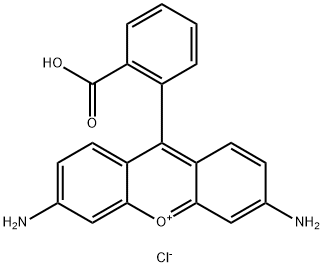
Rhodamine 110 is a green fluorescent cationic dye with excitation and emission maxima of 496 and 520 nm, respectively. When incorporated with a hydrolytic substrate (
e.g., proteinase or peptidase substrates), it can be used as a highly sensitive detection reagent in fluorescence-based enzyme assays. Rhodamine 110 has also been used in a fluorescence quenching method for determining trace nitrite and as a probe for cytochrome P450 activity.
in vivo
Rhodamine 110 is less toxic than the parent molecule based on the intravenous LD50 acute toxicity values of 89.5 mg/kg and 140.0 mg/kg for Rhodamine B and Rhodamine 110, respectively. Both molecules induce liver and kidney enlargement after ingestion, and male rats show more significant increases than female rats after Rhodamine 110 exposure. In addition, testis weight increased in male rats dosed with Rhodamine 110. The pharmacokinetics of Rhodamine 110 are assessed following oral administration at two dosages (3 and 10 mg/kg) and intravenous administration at one dosage (3 mg/kg). Pharmacokinetic parameters are calculated using an extravascular input and IV-bolus input, noncompartmental model analysis conducted with WinNonlin Standard Edition. The pharmacokinetic parameters of Rhodamine 110 indicates that the maximum plasma concentrations (Cmax) of the two oral dosages are 283.4 and 657.0 ng/mL, which are reached at 140 and 210 min, respectively. This indicates that Rhodamine 110 absorption is not rapid after ingestion, as it took over 2 h to be absorbed from the intestines into the blood. The areas under the concentration–time curves (AUCs) for the two dosages are 138.1±20.3 and 444.0±170.8 h ng/mL. The pharmacokinetic data demonstrate that the AUC is proportional to the administered oral dose of Rhodamine 110 (3 mg/kg and 10 mg/kg). Furthermore, the clearance (Cl) of the two orally administered doses is 7.94 and 8.61 mL/min/kg, respectively[1].
References
[1] HEMANT S THATTE PHD . Acidosis-induced apoptosis in human and porcine heart[J]. Annals of Thoracic Surgery, 2004, 77 4: Pages 1376-1383. DOI:
10.1016/j.athoracsur.2003.07.047[2] HUBERT HUG. Rhodamine 110-Linked Amino Acids and Peptides as Substrates To Measure Caspase Activity upon Apoptosis Induction in Intact Cells[J]. Biochemistry Biochemistry, 1999, 38 42: 13906-13911. DOI:
10.1021/bi9913395[3] XIAN ZHANG. A fluorescence quenching method for the determination of nitrite with Rhodamine 110[J]. Spectrochimica Acta Part A: Molecular and Biomolecular Spectroscopy, 2003, 59 8: Pages 1667-1672. DOI:
10.1016/s1386-1425(02)00404-3[4] MELISSA M. YATZECK . A highly sensitive fluorogenic probe for cytochrome P450 activity in live cells[J]. Bioorganic & Medicinal Chemistry Letters, 2008, 18 22: Pages 5864-5866. DOI:
10.1016/j.bmcl.2008.06.015