Chemical Properties
Light-Orange Liquid
Uses
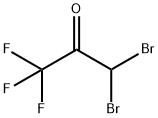
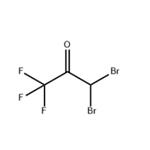
1,1-Dibromo-3,3,3-trifluoroaceton can be used in synthesis of 3,4-disubstituted pyrazole analogues as anti-tumor CDK inhibitors.
Uses
1,1-Dibromo-3,3,3-trifluoroacetone readily forms trifluoropyruvaldehyde hydrate in the presence of aqueous NaOAc, which is a useful intermediate, e.g. in the synthesis of a fused pyrazine derivative.
Synthesis
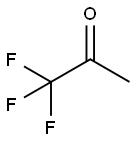
The general procedure for the synthesis of 3,3-dibromo-1,1,1-trifluoro-2-propanone from 1,1,1-trifluoroacetone is as follows:
1. 1,1,1-trifluoroacetone (50.0 g, 446.2 mmol) was dissolved in concentrated sulfuric acid (250 g).
2. bromine (Br2, 81.69 g, 510.1 mmol) was slowly added dropwise to the above solution over a period of 2 hours at room temperature, followed by stirring the reaction mixture overnight.
3. After completion of the reaction, bromine (Br2, 40.85 g, 255.6 mmol) was added again and stirring was continued overnight.
4. At the end of the reaction, the reaction mixture was allowed to stand in order to separate the two phases formed, followed by distillation of the lower phase to give 3,3-dibromo-1,1,1-trifluoroacetone as a yellow oil (10.37 g, 8.6% yield). 5. The structure of the product was determined by 1H-1DOX.
5. The structure of the product was confirmed by 1H NMR (270 MHz, CDCl3) with a chemical shift of 6.23 ppm (s, 1H).
*The synthesis was previously reported in Rec. Trav. Chim. Pays-Bas 1995,114,97-102.
References
[1] Indian Journal of Chemistry, Section B: Organic Chemistry Including Medicinal Chemistry, 1988, vol. 27, # 1-12, p. 1051 - 1053
[2] Recueil des Travaux Chimiques des Pays-Bas, 1995, vol. 114, # 3, p. 97 - 102
[3] Patent: WO2005/58858, 2005, A1. Location in patent: Page/Page column 120
[4] Journal of the American Chemical Society, 1952, vol. 74, p. 3902
[5] Journal of Medicinal Chemistry, 1975, vol. 18, # 11, p. 1106 - 1110