Chemical Properties
off-white crystal powder
Uses
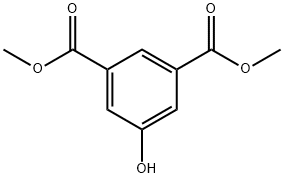
Dimethyl 5-Hydroxyisophthalate is a useful synthetic intermediate in the synthesis of N,N-Bis(2,3-dihydroxypropyl)-5-[(N-(2-hydroxyethyl)carbamoyl)methoxy]-2,4,6-triiodoisophthalamide (B426310); a compound related to Ioversol( I737000) which is a nonionic, low osmolality, radiographic contrast agent.
General Description
Dimethyl 5-hydroxyisophthalate undergoes a base-catalyzed nucleophilic oxirane ring-opening addition reaction with allyl glycidyl ether, to afford 5-substituted derivatives of isophthalic acid. Influence of third component, i.e. a series of 1,ω-alkanediols on the copolymerization reaction of dimethyl 5-hydroxyisophthalate with poly(ethylene glycol) has been studied. Lipase-catalyzed condensation polymerization of dimethyl 5-hydroxyisophthalate with polyethylene glycol is reported.
Synthesis
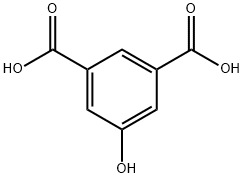
To a 1 L round-bottomed flask equipped with a magnetic stirrer was added 187.8 g (1 mol) of 5-hydroxyisophthalic acid (~97% purity, available from Aldrich) and 500 mL (12.3 mol) of methanol. After slowly adding 28 mL of concentrated sulfuric acid, the reaction mixture was heated to reflux temperature and stirred under reflux conditions for 4 hours. Upon completion of the reaction, the hot reaction solution was carefully poured into 500mL of ice water. Subsequently, the white solid product was collected by filtration and washed several times with deionized water until the washings were neutral. The product was dried under vacuum at 60 °C overnight to give 206.8 g of dimethyl 5-hydroxyisophthalate. The product characterization data were as follows: melting point 164-166 °C; GC purity >99%; yield 98.2%; 1H NMR (CDCl3 + DMSO-d6, TMS as internal standard, ppm): 3.68 (s, 6H, OCH3), 7.45 (s, 2H, Ar-H), 7.89 (s, 1H, Ar-H), 9.35 (broad peak, 1H, OH ); 13C NMR (CDCl3 + DMSO-d6, TMS as internal standard, ppm): 51.92 (OCH3), 120.50 (C4, C6), 121.10 (C2), 131.15 (C1, C3), 157.36 (C5), 165.85 (COOR); 1H-13C NMR correlation spectrum (CDCl3 + DMSO-d6, TMS as internal standard, ppm): 51.92 (quadruple peaks, OCH3, 1JCH = 147 Hz), 120.50 (double peaks, C4, C6, 1JCH = 164.4 Hz), 121.10 (double peaks, C2, 1JCH = 168.3 Hz), 131.15 (single peaks, C1, C3), 157.36 (single peaks , C5), 165.85 (single peak, COOR); GC-MS (acetone as solvent): m/z 210 (M+).
References
[1] Tetrahedron Letters, 1996, vol. 37, # 20, p. 3475 - 3478
[2] Tetrahedron, 1997, vol. 53, # 30, p. 10239 - 10252
[3] Organic and Biomolecular Chemistry, 2007, vol. 5, # 2, p. 276 - 285
[4] European Journal of Organic Chemistry, 2015, vol. 2015, # 32, p. 6988 - 6993
[5] Angewandte Chemie, 1996, vol. 108, # 17, p. 2078 - 2081