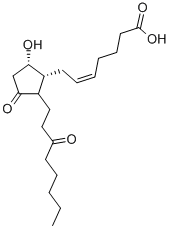
Description
13,14-
dihydro-
15-
keto Prostaglandin D
2 (13,14-
dihydro-
15-
keto PGD
2) is a metabolite of PGD
2 which is formed through the 15-
hydroxy PGDH pathway. 13,14-
dihydro-
15-
keto PGD
2 was recently identified as a selective agonist for the CRTH2/DP
2 receptor. It also inhibits ion flux in a canine colonic mucosa preparation. In humans, 13,14-
dihydro-
15-
keto PGD
2 is further metabolized to give 11β-
hydroxy compounds which have also undergone β-
oxidation of one or both side chains. Virtually no 13,14-
dihydro-
15-
keto PGD
2 survives intact in the urine.
Uses
13,14-Dihydro-15-keto-PGD2 is a metabolite of Prostaglandin D2 (CAT# P838575) and a selective CRTh2/DP2 receptor agonist. CRTh2/DP2 receptors play crucial roles in atopic dermatitis, asthma, and other inflammatory diseases.
References
[1] P K RANGACHARI P A B. Biological activity of metabolites of PGD2 on canine proximal colon.[J]. American Journal of Physiology, 1993, 264 5 Pt 1: G886-94. DOI:
10.1152/ajpgi.1993.264.5.g886[2] H. HIRAI. Prostaglandin D2 Selectively Induces Chemotaxis in T Helper Type 2 Cells, Eosinophils, and Basophils via Seven-Transmembrane Receptor Crth2[J]. The Tokushima journal of experimental medicine, 2001, 1 1: 255-262. DOI:
10.1084/jem.193.2.255[3] T E LISTON L J R. Metabolic fate of radiolabeled prostaglandin D2 in a normal human male volunteer.[J]. The Journal of Biological Chemistry, 1985, 260 24: 13172-13180.
[4] JASON D. MORROW. Quantification of the major urinary metabolite of prostaglandin D2 by a stable isotope dilution mass spectrometric assay[J]. Analytical biochemistry, 1991, 193 1: Pages 142-148. DOI:
10.1016/0003-2697(91)90054-w[5] DAVID MERIWETHER. Apolipoprotein A-I mimetics mitigate intestinal inflammation in COX2-dependent inflammatory bowel disease model.[J]. Journal of Clinical Investigation, 2019, 129 9: 3670-3685. DOI:
10.1172/jci123700[6] VICTORIA GÓMEZ-ABELLÁN . Professional phagocytic granulocyte-derived PGD2 regulates the resolution of inflammation in fish[J]. Developmental and comparative immunology, 2015, 52 2: Pages 182-191. DOI:
10.1016/j.dci.2015.04.017[7] RALF SCHRÖDER. PGH1, the precursor for the anti-inflammatory prostaglandins of the 1-series, is a potent activator of the pro-inflammatory receptor CRTH2/DP2.[J]. PLoS ONE, 2012: e33329. DOI:
10.1371/journal.pone.0033329