Chemical Properties
Brown to Orange Solid
Uses
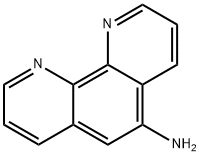
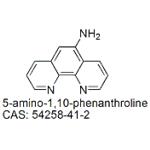
1,10-Phenanthrolin-5-amine is a potential fluorescent label for DNA detection. 1,10-Phenanthrolin-5-amine is used as a mediator for glucose oxidase for development of biosensors and biofuel cells
Uses
1,10-Phenanthrolin-5-amine can be used in the synthesis of bis-[1,10]phenanthrolin-5-yl-pyromellitic diimide (Bphen-PMD), which can find applications in organic light-emitting devices.
Synthesis
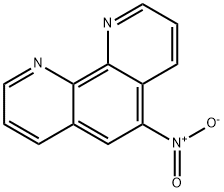
4) Add 0.64 g (6.0 mmol) of 10% palladium-carbon catalyst, 4.85 g of 80% (mass fraction) hydrazine hydrate, and 20.0 mL of anhydrous ethanol to a 250 mL three-neck flask. A reflux condenser was installed and the two remaining ports were sealed with glass stoppers. The device was placed on a DF-101S heated thermostatic magnetic stirrer with the oil bath temperature set to 72 °C and stirring was initiated. Subsequently, 2.03 g (9 mmol) of 5-nitro-1,10-phenanthroline was added to the flask, followed by 40 mL of anhydrous ethanol to ensure complete dissolution (total ethanol volume of 60 mL). The dissolved 5-nitro-1,10-phenanthroline solution was quickly poured into a three-necked flask after the oil bath temperature reached 72 °C. After the reaction lasted for 10 hours, the heating was stopped and left for about 1 hour to ensure complete dissolution of 5-nitro-1,10-phenanthroline. The oil bath was again heated to 60°C. If any precipitate redissolved in the system, the three-necked flask was immediately removed, the solution was poured into a thermal filter, and the residue was washed with anhydrous ethanol about five times. The filtrate was collected and concentrated using a rotary evaporator to remove the solvent, yielding a yellow solid. The solid was dried in a vacuum oven at 60 °C for 12 hours. Finally, the product was recrystallized with anhydrous ethanol, filtered and dried under vacuum at 60 °C for 12 h to give 1.28 g of yellow-brown solid powder, 5-amino-1,10-phenanthroline (Phen-NH2), in 72.9% yield.
References
[1] Chemical Communications, 2006, # 43, p. 4539 - 4541
[2] European Journal of Inorganic Chemistry, 2008, # 10, p. 1559 - 1564
[3] Tetrahedron Letters, 2007, vol. 48, # 18, p. 3135 - 3139
[4] Journal of the American Chemical Society, 2003, vol. 125, # 40, p. 12062 - 12063
[5] Patent: US2007/276104, 2007, A1