Chemical Properties
White to yellow solid
Uses
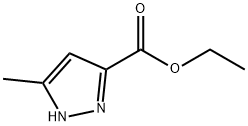
Ethyl 3-methylpyrazole-5-carboxylate may be used to synthesize the following ligands:
- potassium salt of new dihydrobis(3-carboxyethyl-5-methylpyrazolyl)borate (BpCOOEt,Me)
- [(3-carboxy-5-methyl-1H-1-pyrazolyl) (3-methyl-5-carboxy-1H-1-pyrazolyl)methane, which readily forms Zn(II) and Cd(II) complexes
- bis(3-carboxy-5-methyl-1H-1-pyrazolyl)methane, which readily forms Zn(II) and Cd(II) complexes
Uses
Ethyl 3-Methyl-5-pyrazolecarboxylate is a useful synthetic intermediate. It is used to prepare tetrahydroisoquinoline amide substituted Ph pyrazoles as selective Bcl-2 inhibitors. It is also studies as a hypolipidemic agent.
General Description
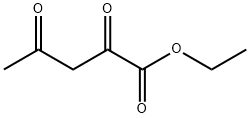
Ethyl 3-methylpyrazole-5-carboxylate can be prepared by reacting ethyl acetylpyruvate and hydrazine.
Synthesis
The general procedure for the synthesis of ethyl 3-methylpyrazole-5-carboxylate from ethyl acetylpyruvate was as follows: hydrazine monohydrate (5.4 mL, 110.68 mmol) was slowly added dropwise to a solution of EtOH/AcOH (100/1 mL) of ethyl 2,4-dioxovalerate (11.67 g, 73.79 mmol) at 0 °C. The reaction mixture was stirred at room temperature for 15 h. The reaction mixture was poured into water (50 mL) and saturated aqueous NaHCO3 solution (5 mL) and extracted with EtOAc (3 x 50 mL). The organic layers were combined, dried with anhydrous Na2SO4, filtered and concentrated under reduced pressure to afford ethyl 5-methyl-1H-pyrazole-3-carboxylate (8.41 g, white solid, 74% yield), which could be used for the subsequent reaction without further purification. The product was characterized as follows: 1H NMR (CDCl3, 250 MHz): δ 6.55 (s, 1H), 4.34 (q, J = 7.13 Hz, 2H), 2.35 (s, 3H), 1.33 (t, J = 7.13 Hz, 3H); EI-MS: m/z = 155 [M+1]+.
References
[1] Journal of Medicinal Chemistry, 2015, vol. 58, # 5, p. 2180 - 2194
[2] Patent: WO2009/7399, 2009, A1. Location in patent: Page/Page column 80
[3] Patent: WO2006/32851, 2006, A1. Location in patent: Page/Page column 39
[4] Bioorganic and Medicinal Chemistry Letters, 2015, vol. 25, # 15, p. 3017 - 3023
[5] Journal of the Chemical Society, 1945, p. 114