Uses
Chloropyramine is used for allergic dermatosis, allergic rhinitis and conjunctivitis, for
drug-induced allergies, in the beginning stages of bronchial asthma, eczema, neurodermatitis,
contact dermatitis, and toxicodermia. It also exhibits a sedative effect. Synonyms
of this drug are suprastin, chlortripelenamine, and synopen.
Definition
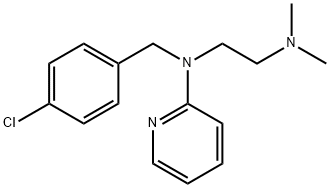
ChEBI: N'-[(4-chlorophenyl)methyl]-N,N-dimethyl-N'-(2-pyridinyl)ethane-1,2-diamine is an aminopyridine.
Synthesis
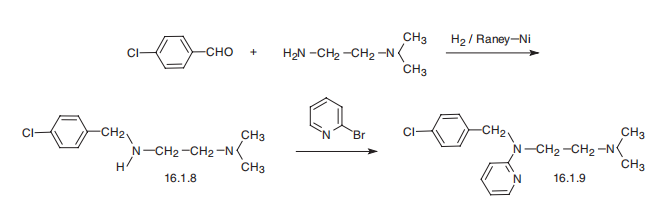
Chloropyramine, N-(4-chlorobenzyl)-N,N-dimethyl-N-2-pyridylethylenediamine
(16.1.9), is synthesized in a somewhat different manner, which is by reacting
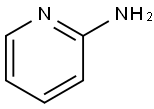
2-brompyridine with N-(4-chlorobenzyl)-N,N-dimethylethylenediamine (16.1.8).
N-(4-Chlorobenzyl)-N,N-dimethylethylenediamine (16.1.8), in turn, is synthesized by
condensation of 4-chlorobenzaldehyde c N,N-dimethylethylenediamine with subsequent
reduction of the imine group.
in vivo
Chloropyramine (i.p.; 10 mg/kg) abolishes hypothermia in rats[2].
| Animal Model: | Rats[2] |
| Dosage: | 10 mg/kg |
| Administration: | Intraperitoneal |
| Result: | Reduced histamine-induced hypothermia. |