Description
SN-38 (86639-52-3), also known as 7-Ethyl-10-hydroxycamptothecin, is the active metabolite of CPT-11 that inhibits DNA topoisomerase I (IC50 values are 0.74 and 1.9 μM in P388 and Ehrlich cells respectively). Inhibits DNA and RNA synthesis (IC50 values are 0.077 and 1.3 μM respectively) but does not affect protein synthesis. SN-38 displays potent antitumor activity against a range of human tumor cell lines (IC50 values are 3.3, 13, 19 and 22 nM for HCT-116, BEL-7402, HL60 and HeLa cells respectively).
Chemical Properties
Light-Yellow Solid
Uses
7-ethyl-10-hydroxycamptothecin (SN 38) is a metabolite of Irinotecan, a DNA topoisomerase inhibitor. SN 38 has been used in trials studying the treatment of Cancer, Advanced Solid Tumors, Small Cell Lung Cancer, Metastatic Colorectal Cancer, and Triple Negative Breast Cancer, among others.
Definition
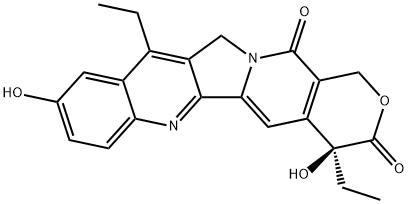
ChEBI: SN-38 (7-Ethyl-10-hydroxycamptothecin) is a member of the class of pyranoindolizinoquinolines that is (4S)-pyrano[3',4':6,7]indolizino[1,2-b]quinoline-3,14-dione bearing two additional ethyl substituents at positions 4 and 11 as well as two additional hydroxy substituents at positions 4 and 9. It is the active metabolite of irinotecan and is ~1000 times more active than irinotecan itself. It has a role as an apoptosis inducer, an EC 5.99.1.2 (DNA topoisomerase) inhibitor, a drug metabolite and an antineoplastic agent. It is a pyranoindolizinoquinoline, a delta-lactone, a tertiary alcohol and a member of phenols.
Preparation
7-Ethyl-10-hydroxycamptothecin (SN-38) was synthesized from 20(S)-camptothecin (1) as the starting material via a three-step route in 30–35% overall yield. first, 7-ethylation of 20(S)-camptothecin was carried out by adding hydrogen peroxide and freshly distilled propionaldehyde to an ice-cold sulfuric acid solution of the substrate in the presence of ferrous sulfate, giving 7-ethylcamptothecin (2) in 77% yield; second, N-oxidation of 2 with 30% H₂O₂ in acetic acid at 70–80 °C for 3.5 h afforded 7-ethylcamptothecin 1-oxide (3) in 78% yield; finally, photochemical 10-hydroxylation of 3 dissolved in dioxane containing an equimolar amount of sulfuric acid under irradiation with a 450 W high-pressure mercury lamp (Pyrex filter) for 30 min furnished compound 4 (SN-38) in 49% yield [5].

Biological Activity
Active metabolite of CPT-11 that inhibits DNA topoisomerase I (IC 50 values are 0.74 and 1.9 μ M in P388 and Ehrlich cells respectively). Inhibits DNA and RNA synthesis (IC 50 values are 0.077 and 1.3 μ M respectively) but does not affect protein synthesis. Displays potent antitumor activity against a range of human tumor cell lines (IC 50 values are 3.3, 13, 19 and 22 nM for HCT-116, BEL-7402, HL60 and HELA cells respectively).
Cytotoxicity
7-Ethyl-10-hydroxycamptothecin has been found to be 200–2000 times more cytotoxic than CPT-11, but has not been used as an anticancer drug due to its poor solubility in pharmaceutically acceptable solvents and low affinity to lipid membranes. SN-38 also undergoes a reversible conversion to an inactive open lactone ring structure at physiological pH.
Synthesis
A new chemical synthesis of SN38 (7-Ethyl-10-hydroxycamptothecin, the active metabolite of prodrug irinotecan), the active metabolite of the camptothecin prodrug irinotecan, has been achieved in 12 steps from simple, commercially available starting materials
[4].

structure and hydrogen bonding
7-Ethyl-10-hydroxycamptothecin belongs to the class of organic compounds known as camptothecins. These are heterocyclic compounds comprising a planar pentacyclic ring structure, that includes a pyrrolo[3,4-beta]-quinoline moiety (rings A, B and C), conjugated pyridone moiety (ring D) and one chiral center at position 20 within the alpha-hydroxy lactone ring with (S) configuration (the E-ring).
References
[1] FUMIAKI KOIZUMI. Novel SN-38-incorporating polymeric micelles, NK012, eradicate vascular endothelial growth factor-secreting bulky tumors.[J]. Cancer research, 2006, 66 20: 10048-10056. DOI:
10.1158/0008-5472.can-06-1605[2] HEYONG GAO. Synthesis and antitumor activity of the hexacyclic camptothecin derivatives[J]. Bioorganic & Medicinal Chemistry Letters, 2005, 15 13: Pages 3233-3236. DOI:
10.1016/j.bmcl.2005.04.063[3] Y KAWATO. Intracellular roles of SN-38, a metabolite of the camptothecin derivative CPT-11, in the antitumor effect of CPT-11.[J]. Cancer research, 1991, 51 16: 4187-4191.
[4] Yao, Y.-S., Liu, J.-L., Xi, J., Miu, B., Liu, G.-S., Wang, S., Meng, L., & Yao, Z.-J. (2011). Total Synthesis of 7-Ethyl-10-hydroxycamptothecin (SN38) and its Application to the Development of C18-Functionalized Camptothecin Derivatives. Chemistry - A European Journal, 17 37, 10462–10469.
https://doi.org/10.1002/chem.201101389[5]
SAWADA, S., OKAJIMA, S., AIYAMA, R., NOKATA, K.-I., FURUTA, T., YOKOKURA, T., SUGINO, E., YAMAGUCHI, K., MIYASAKA, T. (1991). Synthesis and Antitumor Activity of 20(S)-Camptothecin Derivatives: Carbamate-Linked, Water-Soluble Derivatives of 7-Ethyl-10-hydroxycamptothecin. Chemical and Pharmaceutical Bulletin, 39(6), 1446–1454.
https://doi.org/10.1248/cpb.39.1446