Synthesis
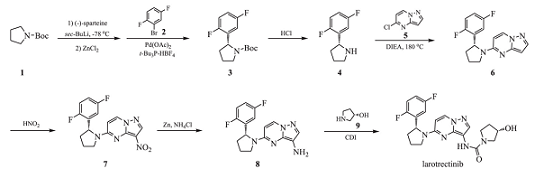
WO2010048314 reported the synthetic route of LOXO-101: N-Boc-pyrrolidine (1) was enantioselectively deprotonated by sec-butyllithium and (-)-cytisine at -78 °C, followed by reaction with ZnCl2 to generate an organozinc compound, which was then Negishi coupled with 2-bromo-1,4-difluorobenzene (2) in the presence of palladium acetate and tri-n-butylphosphine tetrafluoroborate to give (R)-N-Boc-2-(2,5-difluorophenyl)pyrrolidine (3), which was then deprotected with aqueous hydrochloric acid to give (R)-2-(2,5-difluorophenyl)pyrrolidine (4), which was then condensed with 5-chloropyrazolo[1,5-a]pyrimidine (5) in the presence of N,N-diisopropylethylamine to give 6, which was then treated with HNO2.
Nitration yielded 7,7, which underwent nitro reduction in the presence of Zn and NH4Cl to give the corresponding amine (8). 8 and (S)-3-pyrrolidone (9) were then condensed via CDI in CH2Cl2 to give the target product LOXO-101. The synthetic route is shown below.
Description
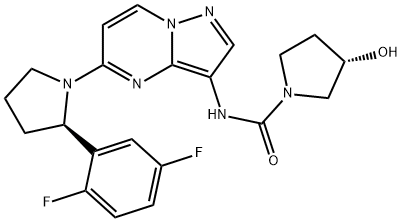
Larotrectinib (VITRAKVIR) is an orally administered, small molecule, highly-selective, tropomyosin receptor kinase (TRK) inhibitor that was developed by Loxo Oncology in collaboration with Bayer AG as a treatment for adult and paediatric patients whose cancers harbour neurotrophic receptor tyrosine kinase (NTRK) gene fusions.
Larotrectinib is a highly selective, potent inhibitor of TRKA, TRKB and TRKC (in vitro 50% inhibitory constant 5–11 nmol/L), with minimal or no activity against other kinase and non-kinase targets [1, 2]. Inhibition of TRKs prevents TRK activation, resulting in both the induction of cellular apoptosis and the inhibition of cell growth in tumours that overexpress TRKs.
Uses
LOXO-101 is a drug used to treat adults and children with certain types of solid tumors that have spread or cannot be removed by surgery and have the NTRK gene fusion. It is also being studied in the treatment of other types of cancer.
Application status
LOXO-101 was the first drug to be specifically developed and approved to treat any cancer containing certain mutations, as opposed to cancers of specific tissues (i.e., the approval is "tissue agnostic"). Several earlier drugs, including pembrolizumab, were eventually approved by the FDA for treatment of specific mutations independent of the type of cancer, but those drugs had been initially developed for specific cancer types.The U.S. Food and Drug Administration (FDA) considers it to be a first-in-class medication.Phase II clinical trials evaluating the drug for efficacy and safety in treating several types of solid tumors are ongoing.[12]Larotrectinib was approved for medical use in the European Union in September 2019.[13][14] It was approved for medical use in Australia in August 2020.
Description
LOXO-101 is an inhibitor of the tropomyosin-related kinases TrkA, TrkB, and TrkC (IC
50s = 2-20 nM). It is selective for TrkA, -B, and -C over a panel of 226 kinases at 1 μM. LOXO-101 inhibits the growth of CUTO-3.29, KM12, and MO-91 patient-derived cancer cell lines (IC
50s = <100, <10, and <10 nM, respectively).
In vivo, LOXO-101 (60 and 200 mg/kg) reduces tumor growth in a KM12 mouse xenograft model.
Description
Larotrectinib, also known as LOXO-101 and ARRY-470, is a small molecule that was designed to block the ATP-binding site of the TRKA, TRKB, and TRKC, serving as a highly specific and potent inhibitor of all of the three tropomyosin kinase receptors.
Uses
Larotrectinib is a TRK Inhibitor (Tyrosine kinase inhibitor).
General Description
Class: receptor tyrosine kinase;
Treatment: NTRK-altered solid tumors;
Other name: ARRY-407, LOXO-101;
Oral bioavailability = 25%;
Elimination half-life = 2.9 h;
Protein binding = 70%
Clinical Use
The US Food and Drug Administration (FDA) granted accelerated approval to larotrectinib (Vitrakvi) on November 26th, 2018, as a treatment for adult and pediatric patients with solid tumors that have NTRK gene fusions without a known acquired resistance mutation, are metastatic or where surgical resection is likely to result in severe morbidity, and have no satisfactory alternative treatments or that have progressed following treatment on. In the approval statement by FDA, a complete response rate of 22% and partial response rate of 53% were cited.
References
[1] JOSEPH R GHILARDI. Administration of a tropomyosin receptor kinase inhibitor attenuates sarcoma-induced nerve sprouting, neuroma formation and bone cancer pain.[J]. Molecular Pain, 2010, 6: 87. DOI:
10.1186/1744-8069-6-87[2] ROBERT C DOEBELE. An Oncogenic NTRK Fusion in a Patient with Soft-Tissue Sarcoma with Response to the Tropomyosin-Related Kinase Inhibitor LOXO-101.[J]. Cancer discovery, 2015, 5 10: 1049-1057. DOI:
10.1158/2159-8290.cd-15-0443[3] YOSEF LANDMAN . Rapid Response to Larotrectinib (LOXO-101) in an Adult Chemotherapy-Naive Patients With Advanced Triple-Negative Secretory Breast Cancer Expressing ETV6-NTRK3 Fusion[J]. Clinical breast cancer, 2018, 18 3: Pages e267-e270. DOI:
10.1016/j.clbc.2017.11.017[4] ALEXANDER DRILON. Efficacy of Larotrectinib in TRK Fusion-Positive Cancers in Adults and Children.[J]. New England Journal of Medicine, 2018, 378 8: 731-739. DOI:
10.1056/nejmoa1714448