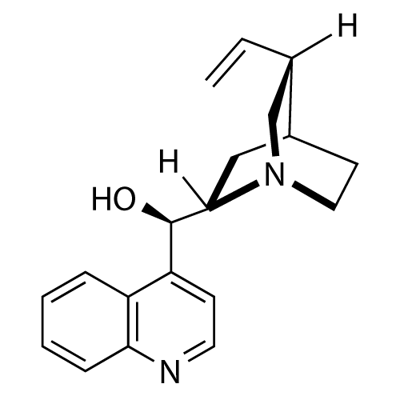
Chemical Properties
white to light yellow crystal powde
Uses
antiamebic, antiprotozoal
Uses
Cinchonidine occurs in most varieties of Cinchona bark and is stereoisomeric with Cinchonine. Cinchonidine exhibits Antimalarial properties.
Definition
ChEBI: 8-epi-Cinchonan in which a hydrogen at position 9 is substituted by hydroxy (R configuration). A diasteroisomer of cinchonine, it occurs in the bark of most varieties of Cinchona shrubs, and is frequently used for
directing chirality in asymmetric synthesis.
Flammability and Explosibility
Non flammable
Synthesis
Bio-inspired synthesis of cinchonidine. An asymmetric synthesis of (+)-cinchonidine proceeds through a visible-light-induced photoredox radical cascade cyclization to build the tetracyclic monoterpenoid indole alkaloid core, followed by a biomimetic cascade rearrangement for the indole-to-quinoline conversion, and is completed by N-Cbz hydrolysis with subsequent intramolecular N4-alkylation; a related bio-inspired route runs from 2 M LiOH hydrolysis and Cbz protection through Weinreb amide formation, mesylation, DIBAL-H reduction, Rose Bengal/O2 photooxidation or DMDO oxidation, LDBBA reduction and NaOH treatment[1]. The specific synthesis steps are as follows:

Purification Methods
Crystallise cinchonidine from aqueous EtOH. For the N-benzylcinchonidinium chloride see above entry in this section. [Beilstein 23 III/IV 2824.]
References
[1]
Liu, W., Qin, W., Wang, X., Xue, F., Liu, X., Qin, Y. (2018). Bioinspired Synthesis of (+)‐Cinchonidine Using Cascade Reactions. Angewandte Chemie, 130(38), 12479–12482.
https://doi.org/10.1002/ange.201804848