Synthesis
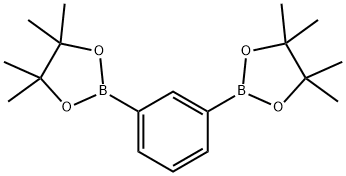
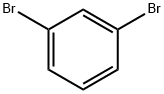
1. 1,3-dibromobenzene (2.5 g, 10.6 mmol), bis(pinacolato)diboron (6.0 g, 23.5 mmol), Pd(dppf)2Cl2 (0.9 g, 1.2 mmol), and potassium acetate (7.1 g, 72.1 mmol) were added into a reaction flask under the protection of argon. 2. The reaction mixture was degassed with argon for three times, then heated to 85 °C under argon atmosphere and reacted for 18 h. 3. After completion of reaction, it was cooled to room temperature and filtered. 4. The filtrate was extracted with ethyl acetate and the organic phases were combined. 5. The reaction mixture was then heated to 85 °C under argon atmosphere for 18 h. 3. After completion of the reaction, the reaction mixture was cooled to room temperature and filtered. 4. The filtrate was extracted with ethyl acetate and the organic phases were combined. 5. The organic phases were washed with water and saturated saline in turn. 6. The washed organic phases were dried with anhydrous sodium sulfate, filtered, and concentrated. 7. The resultant residue was purified by column chromatography on silica gel using an eluent of 1:9 ethyl acetate/hexanes mixture. 8. The eluent was a 1:9 solvent mixture of ethyl acetate/hexane. 8. The target fraction was collected and concentrated to remove the solvent. 9. The product was recrystallized from a solvent mixture of dichloromethane/methanol to give pinacol ester of 1,3-bis(phenylene diboron) acid as an off-white solid (3.008 g, 86% yield). 10.
References
[1] New Journal of Chemistry, 2018, vol. 42, # 6, p. 4728 - 4734
[2] Patent: US2012/226046, 2012, A1. Location in patent: Page/Page column 18; 19
[3] Organic Letters, 2007, vol. 9, # 4, p. 559 - 562
[4] Angewandte Chemie - International Edition, 2016, vol. 55, # 37, p. 11247 - 11250
[5] Angew. Chem., 2016, vol. 128, # 37, p. 11413 - 11417,5