Synthesis
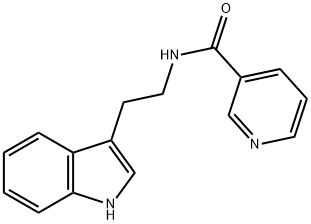
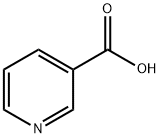
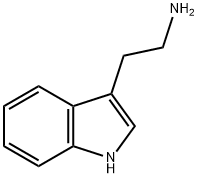
GENERAL STEPS: To a solution of nicotinic acid (0.5 mmol), triethylamine (1.2 mmol), HOBT (0.6 mmol) and EDCI (0.6 mmol) in dichloromethane (8 mL) was added tryptamine (0.5 mmol). The reaction mixture was stirred at room temperature overnight, followed by evaporation under reduced pressure to remove the dichloromethane. The residue was dissolved in ethyl acetate (10 mL) and washed sequentially with 10% aqueous sodium bicarbonate (3 x 10 mL) and water (10 mL). The organic phase was dried over anhydrous sodium sulfate and concentrated to dryness under reduced pressure. The residue was purified by silica gel column chromatography using a solvent mixture of dichloromethane/methanol as eluent to give the pure solid product N-(2-(1H-indol-3-yl)ethyl)nicotinamide (4a). White solid; 72% yield; 1H NMR (500 MHz, DMSO-d6) δ 10.84 (s, 1H), 9.02 (d, J = 1.3 Hz, 1H), 8.82 (t, J = 5.0 Hz, 1H), 8.72 (dd, J = 4.6, 1.3 Hz, 1H), 8.20 (d, J = 7.9 Hz, 1H), 7.60 (d, J = 7.8 Hz, 1H), 7.52 (dd, J = 7.6, 5.1 Hz, 1H), 7.37 (d, J = 8.1 Hz, 1H), 7.21 (s, 1H), 7.09 (t, J = 7.5 Hz, 1H), 7.00 (t, J = 7.4 Hz, 1H), 3.59 (dd, J = 13.6, 6.9 Hz, 2H ), 3.00 (t, J = 7.4 Hz, 2H).
in vitro
Nicotredole inhibits prostaglandin synthetase activity in vitro.
in vivo
Nicotredole produces antiinflammatory effects in carrageenin-induced rat paw oedema.
It reverses pyrogen-induced hyperthermia in rats, elicits analgesic effects in rats, prolongs the time of hexobarbital sleep in rats and inhibits locomotor activity in rats and mice.
Nicotredole (ip) has LD50s of 1260 mg/kg and 1980 mg/kg for male rats and male mice, respectively.
Nicotredole (po) has LD50s of 8.5 g/kg and 9.3 g/kg for male rats and male mice, respectively.
Nicotredole (25 mg/kg; po or ip) undergoes fast absorption (t 1/2 =4.92-17.5 min) and elimination (t 1/2 =55.72-74.52 min), can reach C max (11-13 μg/cm 3 ) after 30 min, and gives AUC values in the range of 21.40-27.30 (μgh/cm 3 ).
References
[1] Herman ZS, et, al. Basic pharmacological properties of a novel antiinflammatory drug tryptamide. Pol J Pharmacol Pharm. Nov-Dec 1987;39(6):729-36. PMID:2972998
[2] Szumio H. Pharmacokinetics of tryptamide following oral and intraperitoneal administration in rats. Acta Pol Pharm. 1990;47(1-2):19-22. PMID:12959253
[3] Kulig D, et, al. A comparison of anti-inflammatory, analgesic and ulcerogenic action of tryptamide, ibuprofen and piroxicam. Pol J Pharmacol Pharm. Nov-Dec 1987;39(6):769-72. PMID:2973002