General Description
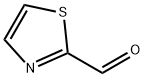
2-Thiazolecarboxaldehyde is a thiazole aldehyde derivative. It undergoes Baylis–Hillman reaction with methyl acrylate catalyzed by DABCO (1,4-diazabicyclo[2.2.2]octane). The reaction mechanism has been studied by electrospray ionization mass spectrometry (ESI-MS).
Synthesis
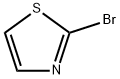
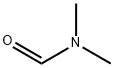
General procedure for the synthesis of 2-formylthiazole from 2-bromothiazole and N,N-dimethylformamide: An ether (43 mL) solution of 2-bromothiazole (10.00 g, 60.96 mmol) was added dropwise to a cooled solvate over a period of 1 hr at -78°C. Subsequently, 1.6 M butyl lithium (46 mL, 73.5 mmol) in hexane was added. The resulting mixture was stirred at -70 °C for 20 min, and then N,N-dimethylformamide (7.50 mL, 97.5 mmol) was added over 1 h while keeping the temperature below -65 °C. The reaction was carried out at -65 °C. The reaction mixture was warmed to -40°C over 1 hr and stirring was continued at this temperature for 1 hr. The reaction mixture was slowly warmed to 0 °C and quenched with 4 M aqueous hydrochloric acid. The organic and aqueous layers were separated. The organic layer was washed with 4M aqueous hydrochloric acid solution and discarded. The combined aqueous layers were neutralized with potassium carbonate and extracted with ether (3 times). The combined organic extracts were dried over magnesium sulfate, filtered, and the solvent was removed in vacuum to give 2-formylthiazole (6.88 g, 99% yield) as a brown oil, which did not require further purification.
References
[1] Patent: WO2006/92268, 2006, A1. Location in patent: Page/Page column 22
[2] Journal of Organic Chemistry, 1995, vol. 60, # 15, p. 4749 - 4754
[3] Patent: US5512575, 1996, A
[4] Zeitschrift fur Naturforschung - Section B Journal of Chemical Sciences, 2007, vol. 62, # 12, p. 1525 - 1529
[5] Patent: WO2018/108125, 2018, A1. Location in patent: Paragraph 00539