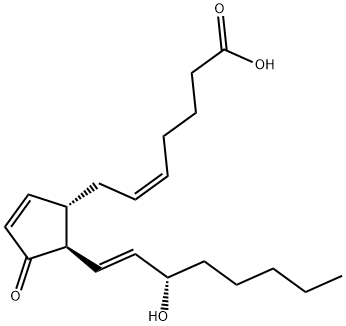
Description
Prostaglandin J
2 (PGJ
2) is formed from PGD
2 by the elimination of the C-
9 hydroxyl group, a process which is accelerated by the presence of albumin. PGJ
2 inhibits platelet aggregation with an IC
50 of about 5-
10 nM. PGJ
2 has antimitotic and antiproliferative effects on a variety of cultured normal cells and tumor cell lines. However, this activity has been attributed to further metabolites of PGJ
2 and not the parent compound itself.
Definition
ChEBI: A member of the class of prostaglandins J that consists of prosta-5,9,13-trien-1-oic acid substituted by an oxo group at position 11 and a hydroxy group at position 15 (the 5Z,13E,15S stereoisomer).
References
[1] D. HAMISH WRIGHT. Characterization of the recombinant human prostanoid DP receptor and identification of L-644,698, a novel selective DP agonist[J]. British Journal of Pharmacology, 2009, 123 7: 1317-1324. DOI:
10.1038/sj.bjp.0701708[2] NICOLE SAWYER. Molecular pharmacology of the human prostaglandin D2 receptor, CRTH2[J]. British Journal of Pharmacology, 2009, 137 8: 1163-1172. DOI:
10.1038/sj.bjp.0704973[3] TENEKA JEAN-LOUIS Maria E F P Patricia Rockwell. Prostaglandin J2 promotes O-GlcNAcylation raising APP processing by α- and β-secretases: relevance to Alzheimer’s disease[J]. Neurobiology of Aging, 2018, 62: Pages 130-145. DOI:
10.1016/j.neurobiolaging.2017.10.009[4] MARIA E. FIGUEIREDO-PEREIRA John B Chuhyon Corwin. Prostaglandin J2: a potential target for halting inflammation-induced neurodegeneration[J]. Annals of the New York Academy of Sciences, 2016, 1363 1: 125-137. DOI:
10.1111/nyas.12987[5] CHUHYON CORWIN. Prostaglandin D2/J2 signaling pathway in a rat model of neuroinflammation displaying progressive parkinsonian-like pathology: potential novel therapeutic targets.[J]. Journal of Neuroinflammation, 2018: 272. DOI:
10.1186/s12974-018-1305-3[6] ABHITA MALAVIYA Paul W S. Synergistic Antiproliferative Effects of Combined γ -Tocotrienol and PPAR γ Antagonist Treatment Are Mediated through PPAR γ -Independent Mechanisms in Breast Cancer Cells.[J]. PPAR Research, 2014: 439146. DOI:
10.1155/2014/439146