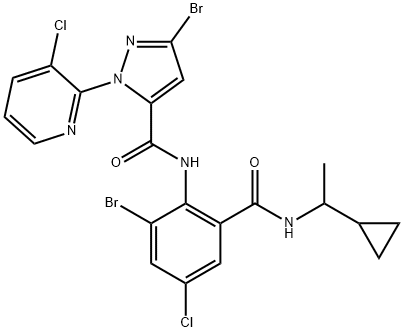
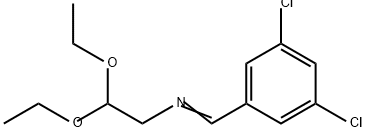
Description
Cyclaniliprole is an insecticide for fruit, greenhouse and some other crops. It has a low aqueous solubility and is non-volatile. It may be environmentally persistent. It has a high to moderate toxicity to most aquatic species, is highly toxic to bees and moderately toxic to earthworms. Cyclanilliprole has a low oral mammalian toxicity.
Uses
Cyclaniliprole is an agrochemical substance used as an insecticide.
Definition
ChEBI: 3-bromo-N-{2-bromo-4-chloro-6-[(1-cyclopropylethyl)carbamoyl]phenyl}-1-(3-chloropyridin-2-yl)-1H-pyrazole-5-carboxamide is a carboxamide resulting from the formal condensation of the carboxylic acid group of 3-bromo-1-(3-chloropyridin-2-yl)-1H-pyrazole-5-carboxylic acid with the primary amino group of 2-amino-3-bromo-5-chloro-N-(1-cyclopropylethyl)benzamide. It is a member of cyclopropanes, a member of pyrazoles, an organobromine compound, a chloropyridine, a secondary carboxamide, a member of monochlorobenzenes and a member of bromobenzenes.
Production Methods
Cyclaniliprole is produced commercially through a multi-step synthesis that constructs its anthranilic diamide framework. Industrial production begins with preparation of a halogenated anthranilic acid derivative, which is functionalised with fluorine substituents to enhance stability and bioactivity. In parallel, a cyano-substituted pyridyl moiety is synthesised via controlled halogenation and nitrile introduction. These fragments are then coupled through amide bond formation under optimised conditions to yield the cyclaniliprole structure. The process requires careful control of halogenation and condensation steps to ensure high yield and purity. After synthesis, the crude product is purified by recrystallisation or chromatography to obtain technical-grade material.
Mechanism of action
Ryanodine receptor modulator
Pesticide Type
Insecticide