Description
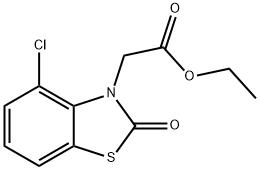
Benazolin ethyl is a post-emergence herbicide. It has a moderate aqueous solubility, is volatile with a low tendency to leach to groundwater. It is not persistent in soil systems but may be persistent in water. Benazolin ethyl has a low mammalian toxicity and is not expected to bioaccumulation. It has a low toxicity to birds and is moderately toxicity to most aquatic organisms and earthworms.
Uses
Agricultural chemical.
Definition
ChEBI: The ethyl ester of benazolin. It is used as a post-emergence herbicide used (generally as a salt or ester) for the control of annual weeds in wheat and oilseed rape. It is not approved for use with the European Union.
Production Methods
Benazolin-ethyl is commercially synthesised through esterification of benazolin acid with ethanol. The production process begins with the preparation of benazolin acid, which involves the chlorination and cyclization of benzothiazole derivatives to form 4-chloro-2-oxo-3(2H)-benzothiazoleacetic acid. This intermediate is then esterified with ethanol in the presence of an acid catalyst to yield benazolin-ethyl. The reaction is typically conducted under reflux conditions to ensure complete conversion and high purity.
Hazard
Moderately toxic by ingestion and skin contact.
Mechanism of action
Selective, systemic growth-regulation action. Synthetic auxin.