Synthesis
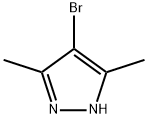
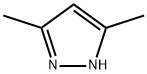
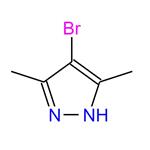
The general procedure for the synthesis of 3,5-dimethyl-4-bromopyrazole from 3,5-dimethylpyrazole is as follows:
1. In a 16 mL vial, 1-benzyl-3,5-dimethyl-1H-pyrazole (196 mg, 1.05 mmol), a magnetic stir bar, 0.7 mL of water, and 0.3 mL of ethyl acetate were added.
2. NaCl (123 mg, 2 mmol) was added and the vial was placed in a room temperature water bath to control the exothermic nature of the reaction.
3. Oxone (322 mg, 0.52 mmol or 1.05 mmol KHSO5) was added and the vial was capped.
4. React under continuous vigorous stirring until thin layer chromatography (TLC) analysis (1 hr) showed complete consumption of the raw material.
5. Reduce the remaining oxidizing agent using solid sodium bisulfite until the starch iodide paper tests negative.
6. Water (5 mL) was added and the reaction mixture was extracted with a 1:1 hexane/ether solvent mixture (3 x 5 mL).
7. The organic phases were combined, dried over anhydrous magnesium sulfate (MgSO4) and concentrated to give the crude product.
8. The crude product was purified by fast chromatography (14 x 1 cm, eluent 9:1 hexane/ethyl acetate) to afford pure 1-benzyl-4-chloro-3,5-dimethyl-1H-pyrazole as a light yellow oil (215 mg, 93% yield).
References
[1] Tetrahedron Letters, 2005, vol. 46, # 40, p. 6833 - 6837
[2] Chemical & Pharmaceutical Bulletin, 1988, vol. 36, # 10, p. 3838 - 3848
[3] Tetrahedron Letters, 2017, vol. 58, # 43, p. 4111 - 4114
[4] Canadian Journal of Chemistry, 1992, vol. 70, # 4, p. 1121 - 1128
[5] Journal of the Chemical Society, 1923, vol. 123, p. 1315