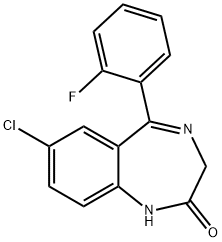
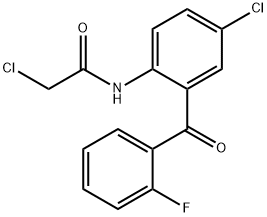
Description
Desalkylflurazepam (Item No. 18484) is an analytical reference material that is structurally categorized as a benzodiazepine. It is an active metabolite of several benzodiazepines, including flurazepam , flutoprazepam, fludiazepam, midazolam, and quazepam. Desalkylflurazepam inhibits L-type voltage-gated calcium channels (Ca
v; IC
50s = 55 and 37 μM for Ca
v1.2 and 1.3, respectively) by positively modulating GABA
A receptors. It can be detected in urine, serum, and meconium by LC-MS/MS. This product is intended for research and forensic applications.
Chemical Properties
Light Yellow Solid
Uses
The major human metabolite of flurazepam. This is a controlled drug precursor therefore a liscence may be required for purchase
Definition
ChEBI: Desalkylflurazepam is a benzodiazepine.
General Description
N-Desalkylflurazepam (also known as norflurazepam, 2886-65-9) is a benzodiazepine analog and an active metabolite of several other benzodiazepine drugs including flurazepam, flutoprazepam, fludiazepam, midazolam, flutazolam, quazepam, and ethyl loflazepate. It is long-acting, prone to accumulation, and binds unselectively to the various benzodiazepine receptor subtypes. It has been sold as a designer drug from 2016 onward.
Mode of action
N-Desalkylflurazepam is a benzodiazepine analog and an active metabolite of several other benzodiazepine drugs including flurazepam, flutoprazepam, fludiazepam, midazolam, flutazolam, quazepam, and ethyl loflazepate. It is long-acting, prone to accumulation, and binds unselectively to the various benzodiazepine receptor subtypes. It has been sold as a designer drug from 2016 onward.
References
[1] DAMIEN E EARL E I T. Inhibition of recombinant L-type voltage-gated calcium channels by positive allosteric modulators of GABAA receptors.[J]. Journal of Pharmacology and Experimental Therapeutics, 2011, 337 1: 301-311. DOI:
10.1124/jpet.110.178244[2] STEPHANIE J MARIN. Quantitation of benzodiazepines in urine, serum, plasma, and meconium by LC-MS-MS.[J]. Journal of analytical toxicology, 2008, 32 7: 491-498. DOI:
10.1093/jat/32.7.491