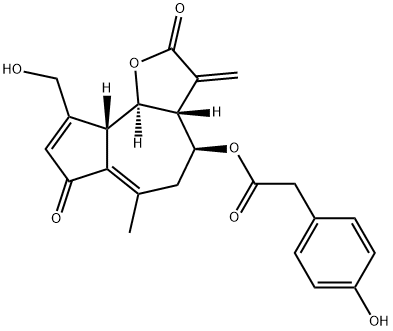
Uses
Lactupicrin (Lactucopicrin) exhibits analgesic, sedative, antimalarial activities and atheroprotective effect. Lactupicrin inhibits acetylcholinesterase (AChE) with an IC50 of 150.3 μM. Lactupicrin is an orally active characteristic bitter sesquiterpene lactone[1][2][3][4][5].
Definition
ChEBI: Lactucopicrin is an azulenofuran, a cyclic terpene ketone, an enone, a member of phenols, a sesquiterpene lactone and a primary alcohol. It has a role as a plant metabolite, a sedative and an antimalarial. It is functionally related to a 4-hydroxyphenylacetic acid and a lactucin.
in vivo
Lactupicrin (15-30 mg/kg, i.p.) shows analgesic activities and sedative properties in mice[1].
Lactupicrin (1.2-120 mg/kg, p.o., daily, 12 weeks) limits macrophage foam cell formation through a reduction of LOX-1 in lipid rafts, contributing to its atheroprotective effect in ApoE-/- mice[2].
Lactupicrin (1.2-120 mg/kg, p.o., daily, 12 weeks) inhibits early atherosclerosis formation in ApoE-/-mice[3].
Lactupicrin (1.2-120 mg/kg, p.o., daily, 12 weeks) reduces ApoE-/-mice serum levels of IL-1β and TNF-α but not IL-6 dose-dependently[3].
| Animal Model: | Male Albino Swiss mice, weighing 24-28 g[1]. |
| Dosage: | 15, 30 mg/kg |
| Administration: | i.p. |
| Result: | Prolonged the latency towards a noxious stimulus by 142 %.
Showed significant antinociceptive activities.
Decreased the spontaneous locomotor activity at a dose of 30 mg/kg (but not 15 mg/kg).
|
| Animal Model: | ApoE-/- mice (C57BL/6), 8 weeks old, male, were fed with a high-fat diet (21% milk fat, 0.15% cholesterol)[2]. |
| Dosage: | 1.2, 12, 120 mg/kg |
| Administration: | p.o., daily, 12 weeks |
| Result: | Reduced the percentage of F4/80 (a marker to identify macrophage) positive derived foam cells within plaques at the aortic sinus dose-dependently.
Reduced the mRNA levels of Lox1 and F4/80 in aortic arches dose-dependently.
|
| Animal Model: | Male ApoE-/- mice (C57BL/6), 6-8 weeks old, were fed a high fat diet (21% milk fat, 0.15% cholesterol)[3]. |
| Dosage: | 12, 120 mg/kg |
| Administration: | p.o., daily, 12 weeks |
| Result: | Reduced the atherosclerotic plaque area at the sites of both aortic sinus and thoracic and abdominal aortas.
Reduced the percentage of CD68 and F4/80 (two widely used markers to identify macrophages) positive
cells within plaques at the aortic sinus.
|
References
[1] Wesoowska A, et, al. Analgesic and sedative activities of lactucin and some lactucin-like guaianolides in mice. J Ethnopharmacol. 2006 Sep 19;107(2):254-8. DOI:
10.1016/j.jep.2006.03.003[2] Li Q, et, al. Terpene Lactucopicrin Limits Macrophage Foam Cell Formation by a Reduction of Lectin-Like Oxidized Low-Density Lipoprotein Receptor-1 in Lipid Rafts. Mol Nutr Food Res. 2022 Feb;66(4):e2100905. DOI:
10.1002/mnfr.202100905[3] He L, et al. Lactupicrin Inhibits Cytoplasmic Dynein-Mediated NF-κB Activation in Inflammated Macrophages and Alleviates Atherogenesis in Apolipoprotein E-Deficient Mice. Mol Nutr Food Res. 2021 Feb;65(4):e2000989. DOI:
10.1002/mnfr.202000989[4] Bischoff TA, et al. Antimalarial activity of lactucin and lactucopicrin: sesquiterpene lactones isolated from Cichorium intybus L. J Ethnopharmacol. 2004 Dec;95(2-3):455-7. DOI:
10.1016/j.jep.2004.06.031[5] Rollinger JM, et al. Application of the in combo screening approach for the discovery of non-alkaloid acetylcholinesterase inhibitors from Cichorium intybus. Curr Drug Discov Technol. 2005 Sep;2(3):185-93. DOI:
10.2174/1570163054866855