Synthesis
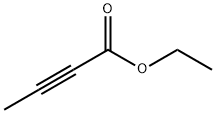
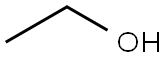
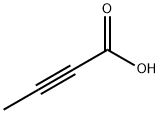
Propynic acid (0.51 mmol) and ethanol (0.56 mmol) were dissolved in 1 mL of dichloromethane. This solution was then slowly added dropwise at 0°C to 1 mL of dichloromethane containing N,N'-dicyclohexylcarbodiimide (0.51 mmol) and 4-dimethylaminopyridine (1 mol%). The reaction mixture was stirred at room temperature for 3 hours. After the reaction was complete, the reaction mixture was diluted with water and extracted with ethyl acetate. The separated organic layer was washed with brine (2 mL) and dried over anhydrous magnesium sulfate. The magnesium sulfate solid was removed by filtration. The filtrate was concentrated under vacuum, and the residue was purified by silica gel column chromatography (using a 10:1 mixture of ethyl acetate and n-hexane) to obtain the target product, ethyl 2-butynedoate.

Figure 2. Synthetic Route of Ethyl 2-butynoate
Chemical Properties
Ethyl 2-butynoate is gray or reddish brown solid powder at room temperature and pressure, insoluble in water, soluble in ethyl acetate and chloroform.
Uses
Ethyl 2-butynoate is used as a precursor for the synthesis of 3-ethyl, 1-methyl 1-(2-nitrophenyl)-cyclopent-3-ene-1,3-dicarboxylate, alkenylsilanols and tricyclic aziridine derivatives. It acts as a methanogenesis inhibitor. As an electron deficient alkyne derivative, it plays a vital role in the preparation of 1,3-dienes catalyzed by rhodium(I)/H8-BINAP complex.
Uses
Ethyl 2-butynoate was used in the study of its effect on
in vitro degradation and microbial biomass production.
It may be used in the synthesis of the following:
- 3-ethyl, 1-methyl 1-(2-nitrophenyl)-cyclopent-3-ene-1,3-dicarboxylate
- tricyclic aziridine derivatives
- alkenylsilanols
Synthesis Reference(s)
Organic Syntheses, Coll. Vol. 7, p. 226, 1990
The Journal of Organic Chemistry, 38, p. 3588, 1973
DOI: 10.1021/jo00960a032
General Description
Ethyl 2-butynoate, a 2-alkynoate is a methanogenesis inhibitor. It is an electron deficient internal alkyne that has been reported to undergo codimerization with alkenes to form 1,3-dienes catalyzed by rhodium(I)/H
8-BINAP complex. The annulation of thioamides with ethyl 2-butynoate catalyzed by tri-
n-butylphosphine to form thiazolines has been investigated.