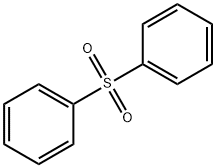
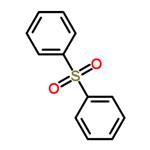
Description
Diphenyl sulfone (DPS) serves as a specialized polymerization solvent for polyetheretherketone (PEEK) copolymers and their composites. The high boiling point and thermal stability of DPS allow the polymerization reaction to proceed smoothly at higher temperatures (160–320 °C), resulting in high-molecular-weight polymers. The resulting PEEK polymers can be used as implant materials in orthopedic spinal surgery[1].
Chemical Properties
Diphenyl sulfone is a sulfone compound having two S-phenyl substituents. It is a crystalline powder that is soluble in organic solvents. It has been found in plants like Gnidia glauca and Dioscorea bulbifera. It has a role as a plant metabolite.
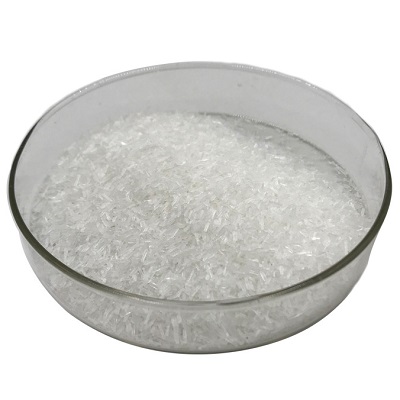
Diphenyl sulfone is formed under certain conditions by the action of aqueous sulfuric acid on benzene. It is used as a high temperature solvent. Such high temperature solvents are useful for processing highly rigid polymers, e.g., PEEK, which only dissolve in very hot solvents.
Uses
Phenyl Sulphone undergoes deoxygenation with Mg-MeOH at room temperature.
Uses
Diphenyl sulfone was identified as the preferred solvent. Diphenyl sulfone is chemically and thermally stable as compared to dimethyl sulfoxide.
Definition
ChEBI: Diphenyl sulfone is a sulfone compound having two S-phenyl substituents. It has been found in plants like Gnidia glauca and Dioscorea bulbifera. It has a role as a plant metabolite
Hazard
Diphenyl sulfone (DPS) is irritating to humans. Exposure may cause skin irritation and severe eye irritation, and may also cause respiratory tract irritation. Ingestion may result in acute poisoning.
Flammability and Explosibility
Not classified
Preparation
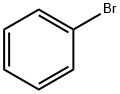
Diphenyl sulfone is produced by the sulfonation of benzene with sulfuric acid and oleum. It is also produced from benzenesulfonyl chloride and benzene.
Purification Methods
Crystallise the sulfone from diethyl ether. It has been purified by zone melting. [Beilstein 6 H 300, 6 IV 1490.]