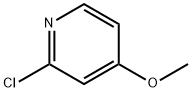
General Description
2-Chloro-4-methoxypyridine can be obtained from the reaction between 2-chloro-4-nitropyridine and sodium methoxide in the presence of dioxane. It can also be prepared starting from 4-methoxy-2(1
H)-pyridone and 4-nitropyridine
N-oxide.
Synthesis
At room temperature, 4-tert-butylpyridine (5.5 mL, 5.08 g, 37.5 mmol, Aldrich) was dissolved in acetic acid (30 )
mL, Fluka). Hydrogen peroxide was added (30% aqueous solution, 11.5 mL, containing 3.83 g H2O2, 113
mmol, excess, Fluka.). The reaction mixture was stirred at 80 C overnight. It was rotor evaporated to 1/3 of its volume, neutralized with aqueous Na2CO3 and extracted several times with CH2Cl2. The organic layer was evaporated to dryness. The starting material (0.2-1.0% CH3OH in CH2Cl2) was removed and the product (5-7% CH3OH in CH2Cl) was recovered by chromatographic purification (run twice; silica, 2 x 25 g). 2-chloro-4-methoxypyridine. The reaction was carried out in dry DMF under argon. At room temperature, sodium methanol (190) was added to the reaction.
mg, 3.52 mmol, excess, Fluka) was added to 2-chloro-4-nitropyridine (500 mg, 3.15
mmol, Aldrich) in DMF immediately undergoes an exothermic reaction and the color of the mixture changes from light yellow to dark red. Stirring for 3 h at room temperature gave a brown suspension which was extracted with water and ether. The organic layer was washed with water to remove the DMF. purification by chromatography (silica, 10 g; CH2Cl2) afforded the colorless oily product 2-chloro-4-methoxypyridine: 393
mg (2.74 mmol, 87%).